
Here’s the short version: practice is the noun, and practise is the verb. If you’re talking about the thing itself (a habit, a session, a business), use practice. If you’re talking about the action of doing it, use practise.
This rule applies mainly in British English. In American English, practice covers both jobs, and practise barely shows up at all.
Practise or Practice examples
Quick side by side before we dig deeper:
- She has soccer practice every Tuesday. (noun)
- She needs to practise her free throws. (verb, British English)
- The doctor runs a small practice downtown. (noun)
- He wants to practice law next year. (verb, American English)
Notice how the word changes job, not meaning. That’s really all this comes down to.
Meaning and Definition of Each Word
1. Practice (Noun)
Practice refers to a thing: a repeated activity, a habit, or an established way of doing something. A dentist has a practice. A musician does practice. A company might have a practice of reviewing contracts twice a year.
2. Practise (Verb)
Practise describes an action. It means to do something repeatedly to improve, or to actively carry out a profession or habit. You practise the piano. A lawyer practises law. This spelling only exists in British, Australian, and Canadian English.
Practice meaning
At its core, practice means a routine or repeated action, something done regularly enough that it becomes a pattern. It can describe a physical activity (sports practice), a professional setup (medical practice), or even a custom (a cultural practice). The word carries a sense of consistency, doing something more than once, usually with a goal in mind.
Key Differences Between the Words
The whole confusion boils down to one simple grammar rule most people never learned properly in school:
- Practice = noun (a thing)
- Practise = verb (an action)
American English simplified this by dropping practise entirely. So if you’re writing for a US audience, you genuinely don’t need to worry about this distinction. Practice does double duty.
If you’re writing for a UK, Australian, or Canadian audience, the distinction matters, and getting it wrong is one of those small errors that makes writing look careless.
Comparison Table
| Word | Part of Speech | Region | Example |
| Practice | Noun | US, UK, everywhere | “I have band practice.” |
| Practise | Verb | UK, Australia, Canada | “I practise the guitar daily.” |
| Practice | Both noun and verb | US only | “I practice medicine.” / “I have a practice.” |
Practise or practice makes perfect

The famous saying is spelled “practice makes perfect,” not “practise makes perfect.” Why? Because in this phrase, practice is a noun, it refers to the activity of practicing as a concept, not the act of doing it in that sentence. Even British writers use “practice” here, since the word is functioning as a noun.
Practise or practice meaning
Both words point to the same core idea: doing something repeatedly to build skill or maintain a routine. The meaning doesn’t change between the two spellings. Only the grammatical role shifts. Think of them as two outfits for the same person, not two different people.
Practise or practice quiz
Try these on your own before checking the answers below:
- I need to _____ my Spanish more often.
- The _____ session starts at 6 PM.
- She wants to _____ medicine after graduating.
Answers (British English): 1. practise, 2. practice, 3. practise Answers (American English): all three use “practice”
Practise or practice UK
In UK English, the noun and verb split is taken seriously, especially in formal writing, journalism, and education. Style guides like those from the BBC and Oxford consistently enforce it. If you’re a British writer, memorizing this distinction is worth the effort since it shows up in exams, professional documents, and editorial standards.
Practise or practice grammar
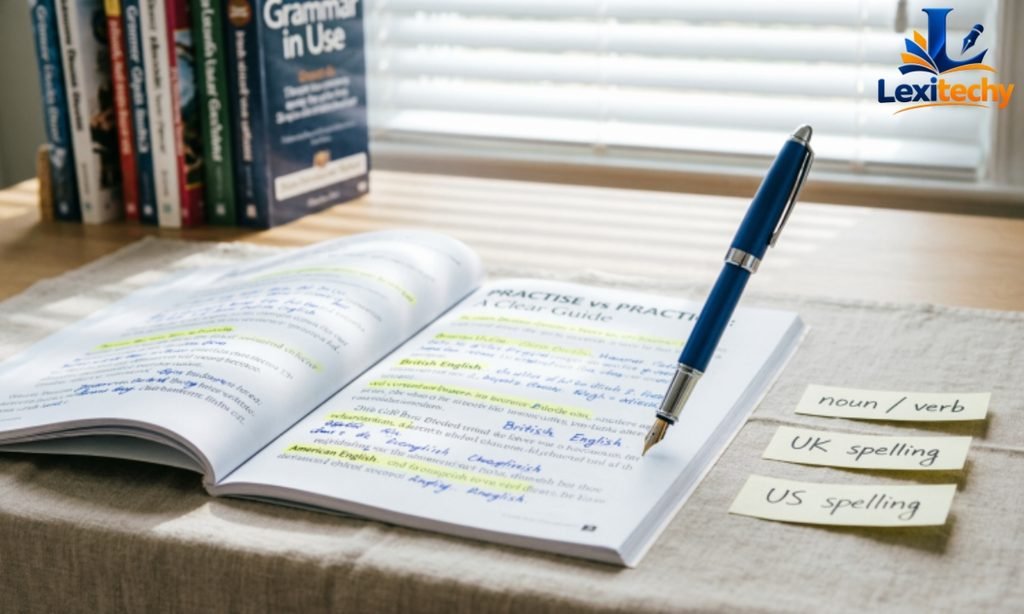
Here’s a trick British grammar teachers love: swap in “advice” and “advise.” Advice is the noun (you give advice), advise is the verb (you advise someone). Since practice/practise follows the exact same pattern as advice/advise, if you can get one pair right, you’ve got the other pair too.
Examples in Sentences
Using Practice (Noun)
- The team has practice every Friday afternoon.
- Good sleep habits are a healthy practice.
- His medical practice has grown over the years.
- It’s common practice to double check your sources.
Using Practise (Verb)
- I practise yoga every morning before work.
- She practises her lines for the play tonight.
- They practise safe habits in the lab.
- He wants to practise as a solicitor.
Common Mistakes
The most frequent error is British writers using “practice” when they mean the verb, largely because American spelling dominates online content, spell checkers, and social media. Another common slip is Americans assuming they’re wrong for using “practice” as a verb, when actually that’s standard in US English.
A subtler mistake: writing “practicing” in UK English. Since practise is the verb, the correct UK spelling is “practising,” not “practicing.”
Tips to Remember the Difference

Here’s a mental shortcut that actually sticks: think of “ice” and “ise” like a pair of twins with different jobs.
- Practice has a “c,” like “ice.” Ice is a noun. Something you hold, use, or refer to.
- Practise has an “s,” like “advice.” Advice is a verb. Something you do.
If that still feels shaky, just remember: advice is to advise as practice is to practise. One phrase, permanent fix.
When to Use Each Word
Use practice when naming a thing: a session, a habit, a business, or a custom. Use practise when describing an action someone is doing, especially in the present or continuous tense. And if you’re writing for American readers, relax; practice alone gets the job done in every context.
Grammar Rules
The noun/verb rule follows a predictable pattern seen across other English word pairs: license/licence, advice/advise, device/devise. In each pair, the “c” version is the noun, and the “s” version is the verb. Once you notice this pattern, the confusion mostly disappears.
Best practise or practice
When people search “best practice” or “best practise,” they usually mean an established, effective method, like in business or workplace contexts. Since this phrase is always a noun (referring to a standard method), the correct spelling in both American and British English is “best practice.” There’s no “best practise” version, even in the UK.
Synonyms or Related Words
Depending on context, you might swap in: rehearsal, training, drill, routine, exercise, habit, custom, or method. None of these carry the exact same noun/verb split as practice and practise, which is part of why this particular pair trips people up so often.
Frequently Asked Questions About Practise or Practice
When should I use Practise or Practice?
Use practise as a verb (an action) and practice as a noun (a thing), but only in British, Australian, or Canadian English. In American English, practice covers both.
What does “practise” mean?
Practise means to do something repeatedly to improve at it, or to actively work in a profession, like practising medicine or practising a language.
Does a doctor Practise or Practice?
In American English, a doctor practices medicine (verb) and runs a practice (noun), same spelling either way. In British English, a doctor practises medicine (verb) but still runs a practice (noun).
What does “practices” mean?
“Practices” is the plural form of the noun practice, referring to multiple habits, methods, or routines, such as “healthy eating practices” or “business practices.”
Conclusion
At the end of the day, this comes down to one small rule with a big impact on how polished your writing looks. Practice is the noun, practise is the verb, and this only matters if you’re writing in British English. American writers can use practice everywhere and never think twice.
Once that “advice and advise” trick clicks in your head, you’ll never second guess this spelling again.

Emily Carter is an English content writer and SEO specialist with 5 years of experience in creating clear, helpful, and search-friendly content. She writes about grammar, word meanings, synonyms, vocabulary, and everyday English usage. Her goal is to make confusing words and language rules simple, practical, and easy to understand.


Pingback: To or Too? Easy Rule to Get It Right Every Time
Pingback: Family's or Families? Learn the Correct Use Today
Pingback: Pricey or Pricy? Discover the Correct Spelling
Pingback: Chris's or Chris? Learn the Correct Usage Fast
Pingback: WBY Meaning in Text: Simple Definition & Examples