
You are typing an email, you reach the word, and your fingers freeze. Benefitted or benefited? One extra T looks harmless, yet it makes you wonder if your spell checker is judging you. Relax. Both spellings exist, and choosing the right one takes about ten seconds once you see the pattern. Let’s clear this up.
Quick Answer
Benefited (one T) is the standard spelling in American English. It is also the more common choice in British English. Benefitted (two Ts) is an accepted variant that shows up mostly in British writing.
Both words mean the same thing and sound the same. If you want one safe choice for every audience, use benefited.
Benefitted or Benefited UK
British English is where the confusion lives. UK dictionaries accept both forms, so neither one earns a red underline from a careful editor.
Even so, benefited leads in British books, news sites, and academic papers. Many UK publishers and style guides pick it for consistency. Benefitted survives mainly in personal writing, older texts, and the habits of writers who learned to double consonants.
So a British writer has a real choice. An American writer has a clear default.
| Related Articles You’ll Love |
| Compliment or Complement? Easy Ways to Get It Right |
| 28 Best Ways to Say “Congratulations to Both of You” |
| WBY Meaning in Text: Simple Definition & Examples |
Meaning and Definition of Each Word (Benefitted or Benefited)
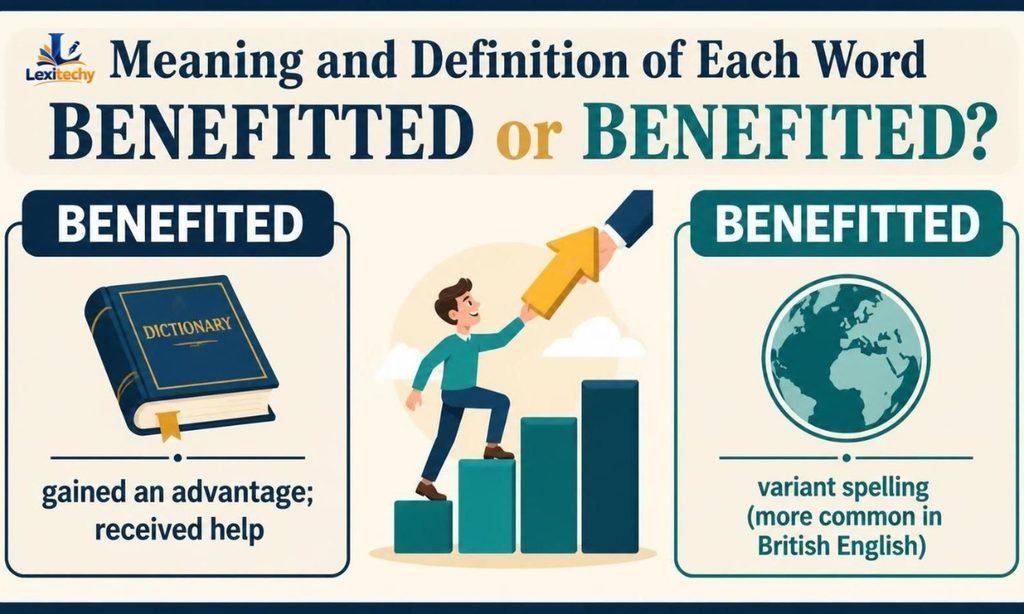
Before comparing spellings, let’s pin down what each word does. Think of them as twins who share one job and one birth certificate.
1. Benefited
Benefited is the past tense and past participle of the verb benefit. It describes someone or something that gained an advantage, or that gave an advantage to another.
- The new bus route benefited every student on campus.
2. Benefitted
Benefitted does exactly the same work. It simply adds a second T before the ending.
- The new bus route benefitted every student on campus.
Read those two sentences again. The meaning does not change by a single atom.
Benefitted or Benefited Meaning
Now let’s look at what the word actually does in a sentence. It works in two directions.
Receiving a gain. Someone gets something good. This version often travels with from.
- Our team benefited from the extra training week.
Giving a gain. Something provides the good thing to someone else.
- The tax change benefited small shop owners.
In both cases, the word signals a positive result. It never describes a loss, which makes it a pleasant word to write on a Monday.
Key Differences Between the Words
The two spellings differ in only a few ways, and none of them change the meaning:
- Spelling: Benefited has one T before -ed. Benefitted has two.
- Region: Benefited is standard in the US. Benefitted appears mainly in UK usage.
- Frequency: Benefited is far more common overall, including in British sources.
- Formality: Both suit formal and casual writing. Benefited looks cleaner to most editors.
- Pronunciation: Identical.
That is the entire list. The gap between these words is smaller than the gap between a Monday and a Tuesday.
Benefitted or Benefited Synonym
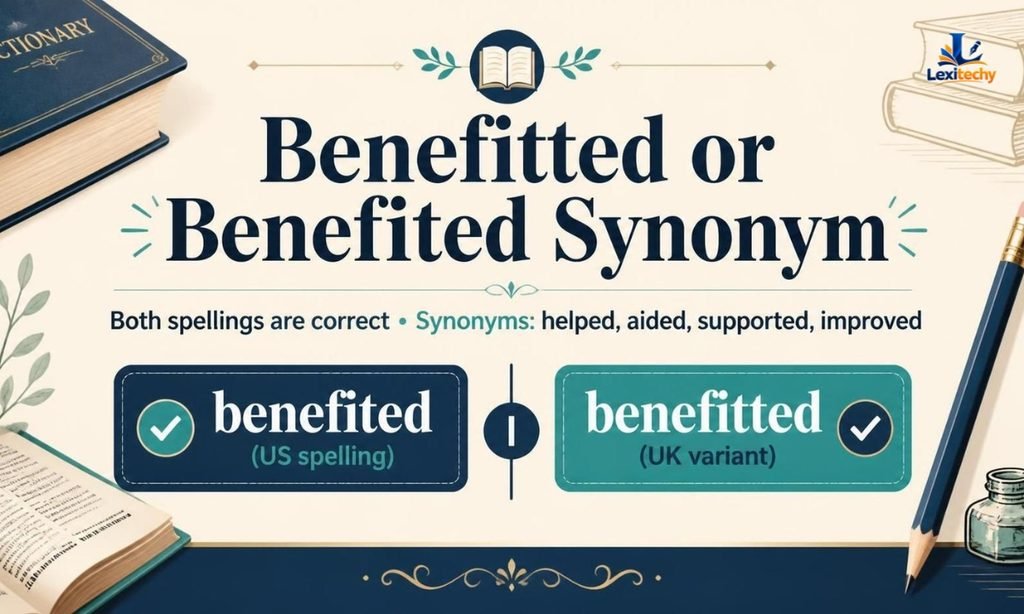
Sometimes the smartest fix is to skip the spelling debate entirely. A synonym lets you dodge the extra T and keep your sentence lively.
- Gained: Local farmers gained from the new market.
- Profited: The shop profited from the holiday rush.
- Improved: Her writing improved with daily practice.
- Thrived: The garden thrived after the rain.
- Helped: The tutoring helped him pass the exam.
Pick the synonym that matches your exact meaning. Profit suggests money, while improvement suggests quality.
Comparison Table
Here is the whole story in one glance.
| Feature | Benefited | Benefitted |
| Number of Ts | One | Two |
| American English | Standard | Rare |
| British English | Common and widely preferred | Accepted variant |
| Meaning | Received or gave an advantage | Received or gave an advantage |
| Pronunciation | BEN-uh-fit-id | BEN-uh-fit-id |
| Present participle | Benefiting | Benefitting |
| Safest for global readers | Yes | Less so |
Examples in Sentences
Seeing the words in action makes the choice feel natural. Let’s go region by region.
Using Benefited (American English)
- Employees benefited from the new remote work policy.
- The city park benefited from a fresh round of funding.
- My sleep schedule has benefited since I stopped checking email at midnight.
- Several students benefited from the free writing workshop.
Using Benefitted (British English)
- Commuters benefitted from the extra evening trains.
- The village hall benefitted from a generous local donation.
- She benefitted greatly from her grandfather’s advice.
- The new library benefitted every school in the borough.
Both lists read smoothly. The only visible difference is that one stubborn extra T.
Benefitted or Benefited Oxford Dictionary
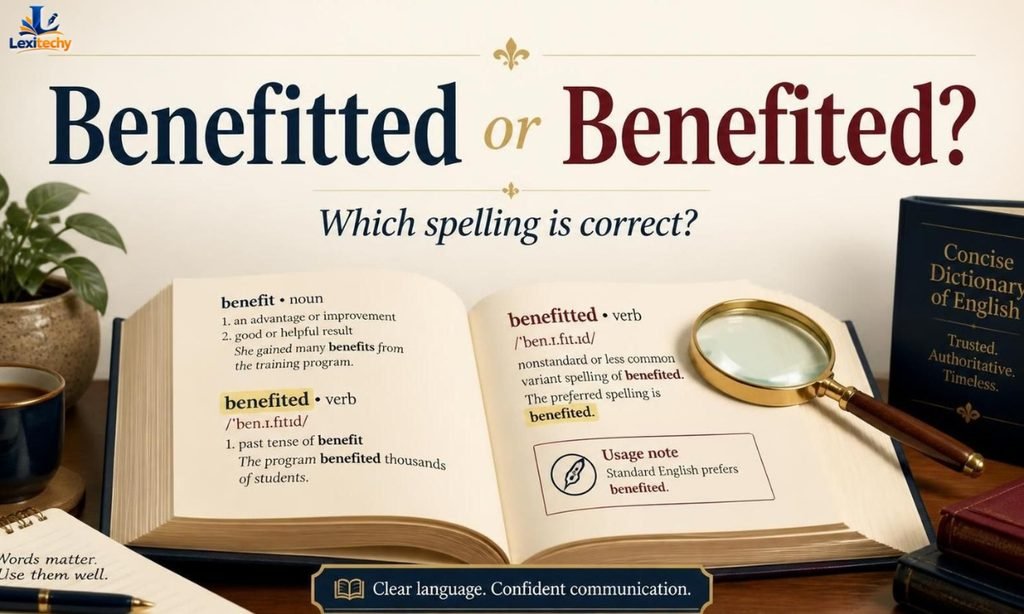
Oxford is the reference many writers trust, so its stance matters. Oxford dictionaries list benefited as the main past form of benefit and note benefitted as a variant, with the double T tied closely to British usage.
The takeaway is simple. Oxford does not call benefitted wrong. It treats it as the less common sibling. Dictionary entries get updated over time, so check the current online entry if you are writing for a publisher with strict rules.
Benefitted Meaning
Let’s treat the double T version fairly, because it carries a story. The word benefit has deep roots. It traces back to the Latin benefactum, which joins bene (well) and facere (to do). It passed through Old French as bienfait and settled into English in the Middle Ages.
That history appears across old texts. The King James Bible, for example, includes the line “forget not all his benefits” in Psalm 103:2. The word has always pointed to good things received.
So where does the second T come from? Writers began doubling the final consonant on the pattern of other verbs, and British English kept that habit alive. The meaning never moved. Benefitted still means “gained an advantage” or “gave one.”
Common Mistakes
Plenty of writers stumble here, and most of the mistakes are easy to fix.
- Writing “benifit.” The correct spelling is benefit, with an e in the middle. The word starts with bene, the same Latin root that gives us benevolent.
- Writing “benefitial.” The adjective is beneficial, with no T before the -cial.
- Mixing spellings in one document. If you write benefited on page one and benefitted on page three, readers will notice. Pick one and stay loyal.
- Using benefitted in a US document. It will not break any law, but American editors will likely change it.
- Confusing the noun and the verb. Benefit works as both. Benefited works only as the verb form.
Fixing these takes seconds, and your writing will look sharper immediately.
Tips to Remember the Difference
Memory tricks work best when they are short and slightly silly. Try these.
- Stress trick: Say the word out loud. The stress lands on BEN, the first syllable. The T stays single because the end of the word is not loud enough to earn a double.
- Region trick: Think “US means one.” One country, one T.
- Guest trick: The second T is like an uninvited guest at a party. You can let it in if you are British, but nobody missed it.
- Default trick: When unsure, use the one T. You will be right in almost every setting.
When to Use Each Word (Benefitted or Benefited)
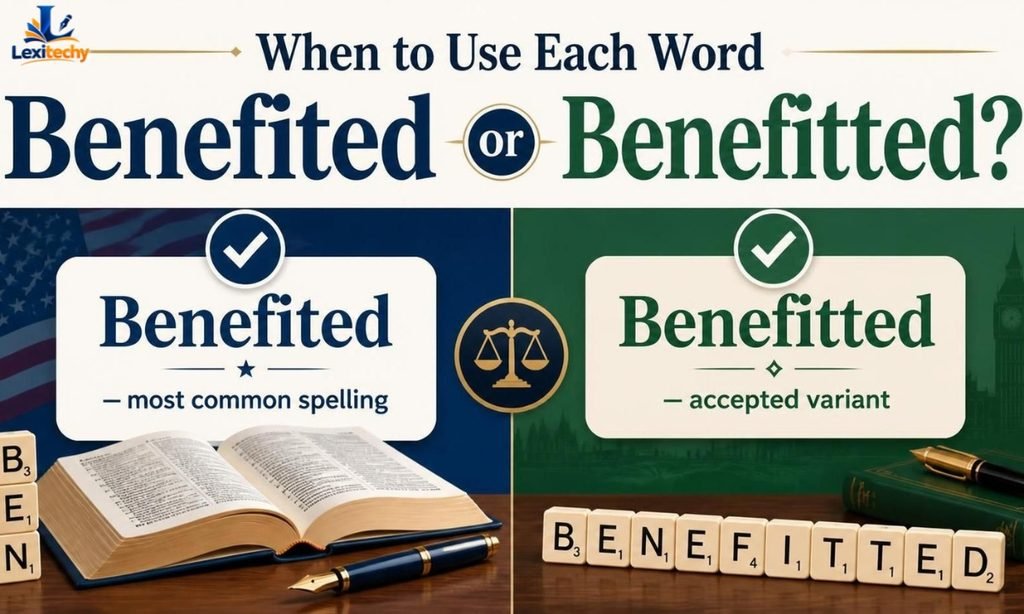
Here is your quick decision guide.
Use benefited when:
- You write for American readers.
- You write for a mixed or global audience.
- Your editor or style guide sets no rule.
- You want the spelling most editors expect.
Use benefitted when:
- A British publication or client specifically prefers it.
- You edit a document that already uses the double T throughout.
Which one should you use?
Use benefited. It is correct in the US, widely accepted in the UK, and the most common form in published English. Choose benefitted only when a specific style guide tells you to.
Grammar Rules (If Applicable)
The spelling puzzle comes down to one rule about doubling consonants. When a verb ends in a single consonant after a single vowel, you double that consonant if the stress falls on the last syllable.
- beGIN becomes beginning (stress on the last syllable, so double)
- reFER becomes referred (same pattern)
- VISit becomes visited (stress on the first syllable, so no double)
- LIMit becomes limited (no double)
- BENefit becomes benefited (no double)
Benefit puts its stress on the first syllable, so the standard rule says no extra T. That is why benefited wins in American English.
British English sometimes doubles consonants even when the stress is elsewhere, but mainly with the letter L, as in travelled and cancelled. Since benefit ends in T and not L, that British habit does not strongly apply. This explains why benefitted is a minor variant and not the main form.
The same logic applies to the -ing form. Benefiting is the standard spelling, and benefitting is the variant.
Benefitted or Benefited Examples
Let’s see the words in more real situations. These examples cover work, school, health, and home.
At work:
- The sales team benefited from the new customer tracking tool.
- Our clients benefited when we cut response times in half.
In school:
- Students who read daily benefited the most from the summer program.
- The class benefited from a teacher who explained things twice.
In health:
- Many patients benefited from a short daily walk.
- He benefited from better sleep and fewer late night snacks.
At home:
- The whole family benefited from a shared dinner routine.
- The garden benefited from compost and a lot of patience.
If you prefer the British form, swap in the double T. The meaning stays the same.
Benefitted or Benefited Pronunciation
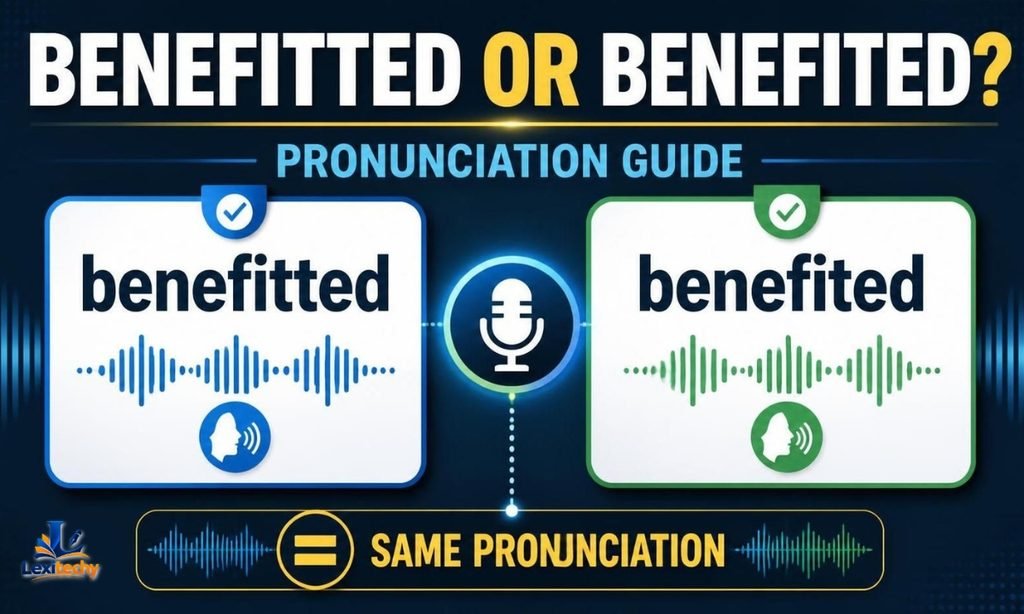
Good news for anyone who reads aloud: the two spellings sound identical.
- Benefited: BEN-uh-fit-id
- Benefitted: BEN-uh-fit-id
- Benefiting: BEN-uh-fit-ing
Say the first syllable with energy and keep the rest light. The unstressed middle syllable often sounds like a soft uh, so the word is rarely pronounced as a crisp “ben-eh-fit.”
Because the sounds match, you can never tell which spelling a speaker had in mind. Spelling is a problem for the page, not for the podcast.
Synonyms or Related Words
Expanding your vocabulary makes your writing richer and helps you avoid repeating one word. These related terms connect to the same Latin root.
- Beneficial: The new schedule proved beneficial to everyone.
- Beneficiary: She named her brother as the beneficiary of the account.
- Benefactor: A local benefactor funded the new reading room.
- Benevolent: The benevolent owner gave every employee a day off.
- Advantageous: The location was advantageous for a small business.
- Profitable: The partnership turned out profitable for both sides.
All of these share the idea of “doing well” or “good results,” which is exactly what bene means.
FAQs About Benefitted or Benefited
Is benefitted or benefited correct spelling?
Both are correct. Benefited is the standard and more common form in both American and British English. Benefitted is an accepted variant, mostly seen in UK writing. Use benefited if you want the safest option.
Which is the correct spelling: benifit or benefit?
The correct spelling is benefit. “Benifit” is a common typo and does not appear in standard dictionaries. Remember that the word starts with bene, the Latin root meaning “well.”
What does “benefited” mean?
Benefited means received or provided an advantage. She benefited from extra practice describes someone who gained something good. The new law benefited small businesses describes something that gave an advantage to others.
Which is correct, benefitted or benefited?
Both are accepted, but benefiting is the standard spelling and the more common one. Benefitting is the variant that follows the double T pattern. Match whichever form you use for the past tense, so benefited goes with benefiting and benefitted goes with benefitting.
Conclusion (Benefitted or Benefited)
So, benefitted or benefited? Both are real words with the same meaning and the same sound. Benefited, with one T, is the clear winner for American readers and the most common choice for British readers too. Benefitted is a valid variant that still lives in some UK writing.
Choose one spelling, stay consistent, and move on with your day. If you ever feel doubt, remember the stress on BEN and keep that second T out of the party. Your writing will look clean, and your spell checker can finally relax.

Emily Carter is an English content writer and SEO specialist with 5 years of experience in creating clear, helpful, and search-friendly content. She writes about grammar, word meanings, synonyms, vocabulary, and everyday English usage. Her goal is to make confusing words and language rules simple, practical, and easy to understand.


Pingback: Goodnight or Good Night? Discover the Correct Spelling
Pingback: Followup or Follow Up? Discover the Correct Usage