
You type a sentence, pause, and stare at the screen. Compliment or complement? Both look right, and spell check stays quiet. Then your boss spots the mistake in a client email, and your face turns the color of a ripe tomato. Relax. One letter decides everything. A compliment is praise, and a complement completes something. Keep reading and you will never mix them up again.
Quick Answer Of Compliment or Complement
Use compliment (with an “i”) when you praise someone or something. Use complement (with an “e”) when one thing completes or improves another.
- She gave me a compliment on my cooking.
- Fresh basil complements tomato soup.
Here is the fastest trick: “I like it” has an I, and “complete” has an E. That is the whole secret, but the sections below cover the traps that catch even careful writers.
| More Articles to Explore |
| 28 Other Ways to Say ‘It Was Nice Talking to You’ (With Examples) |
| 25 Better Ways to Say “Good Morning Everyone” |
| Pricey or Pricy? Discover the Correct Spelling |
Meaning and Definition of Each Word (Compliment or Complement)
These two words sound identical, so the spelling carries all the meaning. Let’s look at each one on its own.
1. Compliment
A compliment is a polite expression of praise or admiration. As a verb, to compliment means to praise someone.
- Noun: “Her teacher paid her a lovely compliment.”
- Verb: “He complimented my presentation.”
2. Complement
A complement is something that completes, balances, or improves something else. As a verb, to complement means to make another thing better or whole by combining with it.
- Noun: “A crisp salad is a great complement to grilled fish.”
- Verb: “Her red scarf complements her gray coat.”
The word also has technical uses. In math, two angles that add up to 90 degrees are complementary angles. In grammar, a complement is the part that completes the meaning of a verb.
Compliment or Complement Examples
Seeing the words in action makes the rule stick faster than any definition.
- My neighbor complimented my garden, and I floated for an hour.
- Cheese and crackers complement each other.
- Receiving a compliment at work can brighten a whole week.
- The new curtains complement the sofa.
Notice the pattern. People give compliments. Things complement other things.
Compliment or Complement Meaning
Why do two words so close in spelling mean such different things? Their history explains it. Both trace back to the Latin word complere, which means “to fill up” or “to finish.”
Complement stayed close to that original idea. It still means something that fills a gap and makes a whole. Compliment took a detour through Italian and Spanish, where it described the courtesies people paid each other to fulfill social duty. Over time, those polite gestures narrowed into the meaning we use today: kind words.
So the two words are cousins who grew up in very different neighborhoods.
Are Compliment or Complement Pronounced the Same?
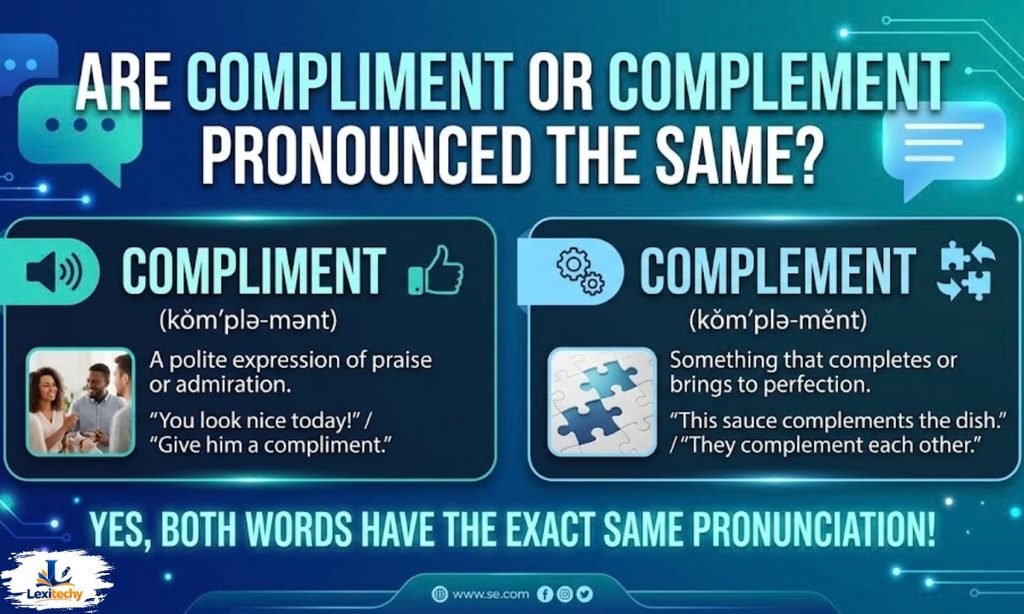
Yes, in everyday speech they sound the same. Both are said roughly as “KOM-pluh-ment” or “KAHM-pluh-ment,” depending on your accent.
That creates a funny problem. Nobody can catch your mistake when you talk, but everyone can when you write. Spoken English forgives you, and written English keeps receipts.
Compliment or Complement UK
British English keeps the same split. Compliment means praise, and complement means completion. The spelling does not change between the US and the UK.
The UK does have a few signature phrases:
- With compliments appears on short notes that accompany a delivered item.
- Compliments slip is a small printed card business with documents.
- Complimentary means free of charge, as in a complimentary biscuit with your tea.
The only real difference is accent, not spelling.
Key Differences Between the Words
Beyond the vowel, these words behave differently in sentences. They also attract different partner words.
- Compliment pairs with verbs like pay, give, receive, and return.
- Complement pairs with words like perfectly, nicely, and each other.
- A compliment involves people and opinions.
- A complement involves things that fit together.
Ask yourself one question: is someone being praised, or is something being completed? The answer picks the word for you.
Is It Compliment or Complement of the Season?
The correct phrase is “compliments of the season.” It is a traditional holiday greeting that means “good wishes for this festive time.”
It uses the plural compliments because it offers polite good wishes, not a completion. “Complements of the season” is a common typo, and it would suggest the season needs finishing. Winter does not need your help.
Staff Compliment or Complement
The business phrase is “staff complement.” It means the full number of employees an organization needs or has on its team.
“The hospital has a full staff complement” means every position is filled. “Staff compliment” would mean praise for the staff, which is lovely but a different thing entirely.
Compliment or Complement Meaning Free
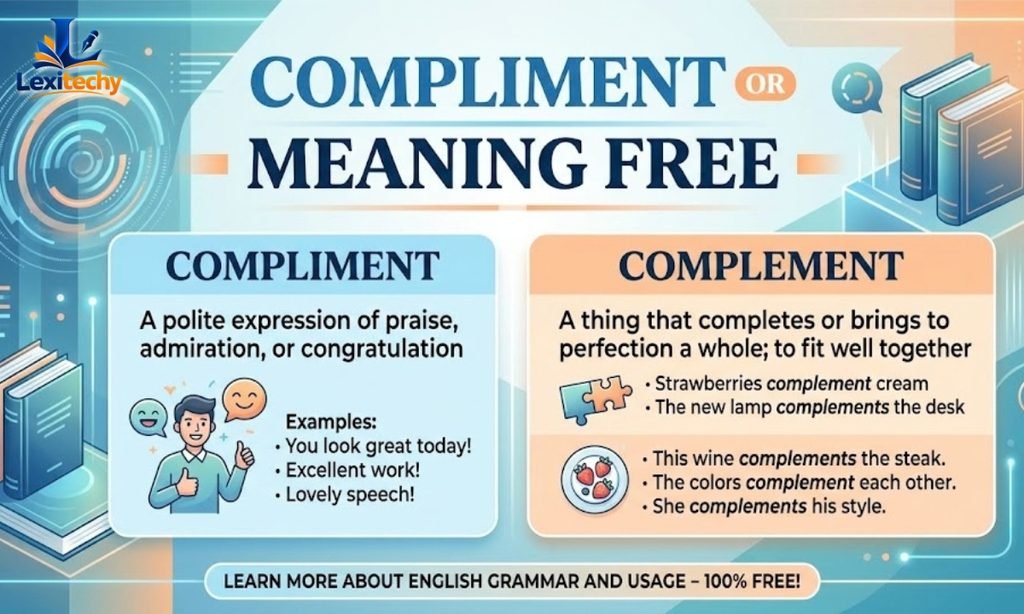
When people ask about the “free” meaning, they usually mean complimentary and complementary. Here is the rule:
- Complimentary means free, given as a courtesy. Think complimentary breakfast.
- Complementary means going well together or completing each other. Think complementary colors.
A hotel gives you a complimentary coffee. A good coffee complements a croissant. Both can happen in the same lobby.
Compliment or Complement
Writers often flip the order in a search, but the order changes nothing. What matters is a quick decision test you can run in two seconds.
Which one should you use?
- Is a person receiving praise? Use compliment.
- Is one thing making another thing whole or better? Use complement.
- Still stuck? Replace the word with “praise.” If the sentence still works, you want compliment.
Comparison Table
| Feature | Compliment | Complement |
| Core meaning | Praise or kind words | Something that completes |
| Memory hook | “I like it” | “Complete” |
| Used with | People | Things |
| Verb example | She complimented him | The wine complements the meal |
| Adjective | Complimentary (free or flattering) | Complementary (matching or completing) |
| Typical phrase | Pay a compliment | Complement each other |
Difference between Compliment or Complement with Examples
Same sentence frame, different letter, different meaning. Study these pairs:
- The chef received a compliment about the sauce. / The sauce is a complement to the pasta.
- My coworker complimented my tie. / My tie complements my shirt.
- She offered a compliment on the design. / The design offers a complement to the room.
Each pair shows the same pattern. People get compliments, and objects get complements.
Examples in Sentences
Now let’s build your instinct with a larger set.
Compliment Examples
- “That is the nicest thing anyone has said to me all week,” she said after the compliment.
- He complimented his sister on her new job.
- Take the compliment and say thank you.
- Her speech earned a compliment from the director.
- A sincere compliment costs nothing and helps everyone.
Complement Examples
- Soft music complements a quiet dinner.
- The new software is a complement to our old system.
- Blue and orange complement each other on the color wheel.
- A good editor complements a good writer.
- The ship carried its full complement of sailors.
Common Mistakes
Most errors come from autopilot typing. The mistakes below appear again and again in emails, resumes, and social posts.
Incorrect vs Correct
- Incorrect: The dessert was a perfect compliment to the meal.
Correct: The dessert was a perfect complement to the meal. - Incorrect: She complemented me on my speech.
Correct: She complimented me on my speech. - Incorrect: Complements of the season!
Correct: Compliments of the season! - Incorrect: The hotel offers complementary breakfast (when it is free).
Correct: The hotel offers complimentary breakfast.
Tips to Remember the Difference

You do not need a dictionary every time. Use one of these three hooks.
1: Compliment = “I like it”
The “i” in compliment matches “I like it.” If you praise something, you like it.
2: Complement = “Complete”
Both words share the letter “e” after the “l.” Complement completes. If something finishes the picture, pick the “e” version.
3: Person vs Thing
Compliments travel from one person to another. Complements connect one thing to another thing. A scarf cannot give a compliment, but it can complement a coat.
Complement of Staff
The idea of a full “complement” reaches beyond offices. Ships, military units, and hospitals all use the word to describe a complete team.
- A ship’s complement is its entire crew.
- A lab’s complement of equipment is everything it needs to run.
- An airline’s cabin crew complement is the number required on a flight.
The meaning never changes. A complement is the amount that makes the whole thing work.
When to Use Each Word (Compliment or Complement)
Here is the cheat sheet you can bookmark.
Use “Compliment” When:
- You praise or admire someone.
- You write a thank you or a polite greeting.
- You describe something offered free (complimentary).
- You sign a note “with compliments.”
Use “Complement” When:
- Two things match, balance, or improve each other.
- You describe a full number or set (staff complement).
- You talk about colors, flavors, or design pairings.
- You discuss angles or grammar structures.
Grammar Rules (If Applicable)
Both words work as nouns and verbs, so the grammar is simple once you spot the part of speech.
Compliment (Noun & Verb)
- Noun: “She received a compliment.”
- Verb: “He complimented the team.”
- Adjective: complimentary, meaning praising or free.
Complement (Noun & Verb)
- Noun: “Rice is a complement to curry.”
- Verb: “The tie complements the suit.”
- Adjective: complementary, meaning completing or matching.
Both verbs take a direct object. You compliment someone, and you complement something.
Synonyms or Related Words
Good synonyms help you test your choice. If a synonym fits, you have the right word.
For compliment, try praise, flattery, admiration, tribute, or commendation.
Synonyms for Complement:
- Completion
- Counterpart
- Finishing touch
- Accompaniment
- Match
- Enhance (verb)
Compliment or Complement Are Homophones
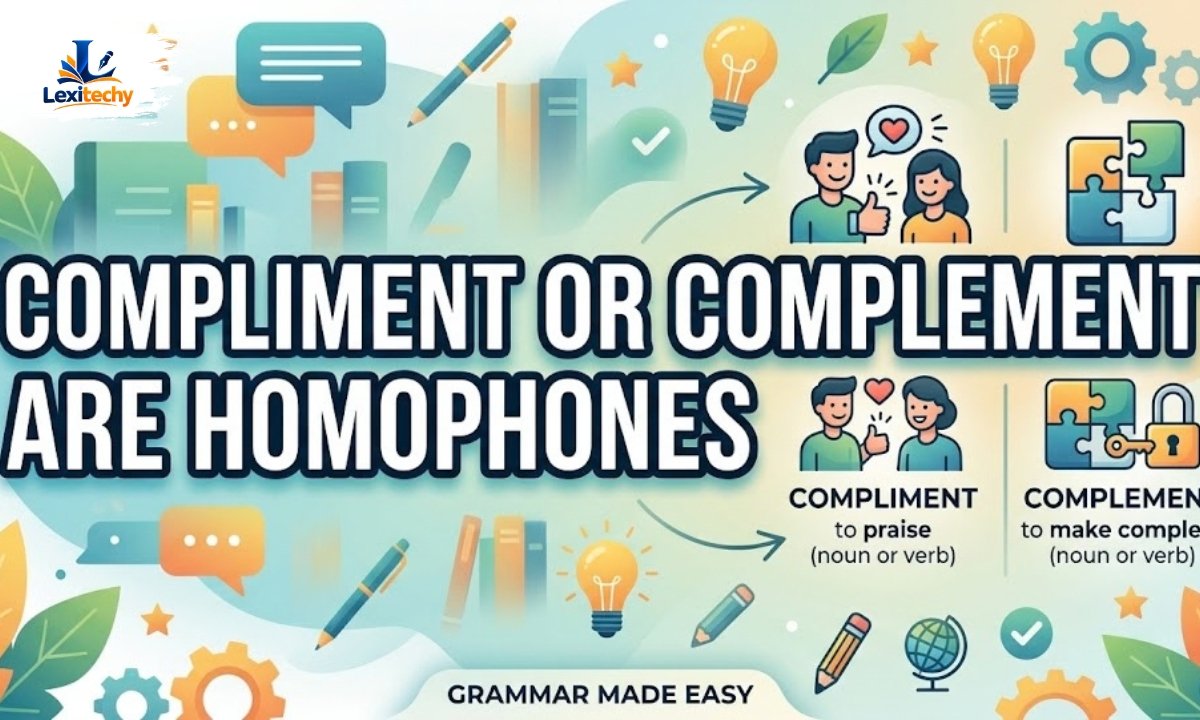
Homophones are words that sound alike but have different meanings and spellings. Compliment and complement belong to a famous family that includes principal and principle, stationary and stationery, and their and there.
English has plenty of these tricks. The best defense is a memory hook, and you now have three.
FAQs About Compliment or Complement
What is the difference between compliment and complement?
A compliment is praise, and a complement is something that completes or enhances another thing. The spelling is the only difference in sound.
Is free food complimentary or complementary?
Free food is complimentary. Complementary describes items that go well together.
What does compliment mean?
Compliment means a polite expression of praise, admiration, or approval. As a verb, it means to praise someone.
Is it compliment or complement in the UK?
The UK uses both words with the same meanings as the US. Only the accent changes.
Conclusion (Compliment or Complement)
Compliment and complement sound like twins, but they live different lives. One praises, and the other completes. Remember “I like it” for compliment and “complete” for complement, and you will stay safe in every email, post, and holiday card.
Next time you pay someone a compliment, you can smile knowing the spelling is right too. And if you ever feel unsure, run the praise test.

Emily Carter is an English content writer and SEO specialist with 5 years of experience in creating clear, helpful, and search-friendly content. She writes about grammar, word meanings, synonyms, vocabulary, and everyday English usage. Her goal is to make confusing words and language rules simple, practical, and easy to understand.


Pingback: Benefitted or Benefited? Discover the Correct Spelling
Pingback: Verbage or Verbiage? Discover the Correct Word