
Have you ever typed a quick reply to a friend and stopped to wonder whether a word is spelled with a “d” or a “t” in the middle? Many people hear the word and picture the wrong spelling, which is why the search diddo or ditto comes up so often. It is an easy slip, and careful writers make it too.
This article gives you the answer right away and then explains why it is correct. You will learn what ditto means, why diddo is considered a spelling mistake, and how to use ditto in texts, emails, and everyday conversation. Along the way, you will find simple examples, a short word history, and answers to common questions so you can spell it with confidence.
Quick Answer
The correct spelling is ditto, with two t’s. Diddo is not a standard English word, and major dictionaries do not list it. If you are asking, “is it diddo or ditto,” the answer is always ditto.
Ditto means “the same” or “I feel the same way.” People use it to avoid repeating something that was just said, in speech, in text messages, and in lists. If a friend writes, “I can’t wait for the weekend,” and you feel the same, you can reply, “Ditto!”
Why People Confuse Them
The main reason is sound. In American English, a “t” between two vowels often sounds like a soft “d,” so ditto can sound a lot like “diddo” when spoken quickly. The same thing happens in words like “butter,” “water,” and “city,” which many speakers pronounce with a light “d” sound.
Another reason is that ditto is used more in speech and casual messages than in formal writing. Many people hear it far more often than they see it, so they never get a clear picture of the spelling. There is also a familiar look-alike: “kiddo” is spelled with two d’s, so “diddo” feels like it could follow the same pattern.
Key Differences At A Glance
Here is a quick comparison of the two spellings:
- Ditto: a real English word, found in every major dictionary.
- Diddo: not a word in standard English, and a common misspelling of ditto.
- Ditto: means “the same” or “likewise.”
- Diddo: has no accepted meaning, so it cannot be used correctly.
- Ditto: works in texts, speech, lists, and casual writing.
- Diddo: should be corrected in any kind of writing.
The takeaway is simple. There is only one correct choice, and it is ditto.
Meaning and Usage Difference
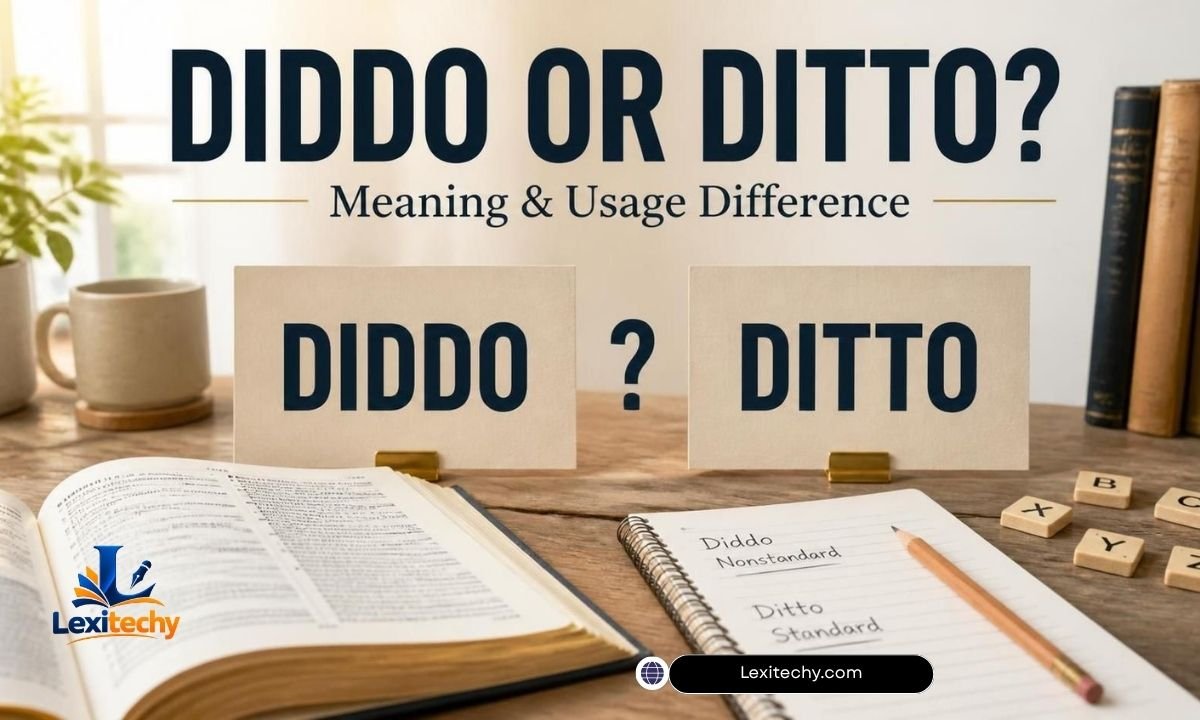
Because diddo is not a real word, the diddo or ditto meaning difference comes down to one word that has a meaning and one that does not. Ditto has a clear job in English. It repeats or agrees with what has already been said without saying it all over again.
You can use ditto in a few common ways:
- To agree: “I’m tired.” “Ditto.”
- To return a sentiment: “Have a great day!” “Ditto!”
- To mean “the same as above” in a list or table.
In each case, ditto saves time and keeps the sentence short. It works because the listener or reader already knows what is being repeated.
Tone, Context, and Formality
Ditto is informal and friendly. It fits well in conversation, text messages, social media replies, and notes between coworkers or family members. It sounds quick and warm, which is why people often use it for short, kind exchanges like “Love you.” “Ditto.”
In formal writing, ditto is usually a poor fit. A business report, a legal letter, or an academic paper is better served by phrases such as “the same,” “likewise,” or “as stated above.” The one place where ditto still looks natural in formal documents is in older-style lists, where ditto marks show that an item repeats the one above it.
What Does Diddo Mean?
Diddo does not mean anything in standard English. When readers search for diddo meaning, they are almost always looking for ditto. The spelling appears because people write it the way it sounds.
It is worth knowing that “diddo” can show up as a name, a brand, or a nickname in some places, and that kind of use is separate from the everyday word. In ordinary writing, though, a sentence like “I’m hungry.” “Diddo.” contains a spelling error. The fix is to change it to “Ditto.”
Which One Should You Use?
Use ditto every time. Whether you are texting, writing an email, or posting a comment, ditto is the only spelling that readers will recognize as correct. A spell checker will usually flag diddo, and many will suggest ditto right away.
If you want an easy way to remember it, think of the word “attitude” or “little.” Both have a “t” that can sound a bit like a “d” in American speech, but both are spelled with t’s. Ditto follows the same pattern: say it fast, but spell it with a t.
Ditto Pokémon
Some readers land on this topic because of Ditto the Pokémon. Ditto is a Normal-type Pokémon that first appeared in the original games, and it is known for its ability to transform into other Pokémon. The name fits well, because ditto means “the same,” and Ditto copies whatever it faces.
The spelling is the same as the everyday word: D-I-T-T-O. Fans sometimes search “diddo” by mistake, but the character’s name has always been Ditto. If you are writing about the game or the franchise, capitalize it as a proper name, as in “Ditto can copy its opponent.”
Pronunciation and Usage Details
Ditto is pronounced “DIT-oh.” The stress falls on the first syllable, and the ending is a clear “oh” sound. In careful speech, the middle consonant sounds like a “t.” In fast, casual American speech, it often softens into a quick “d” sound, which explains why the misspelling happens.
Knowing this helps with ditto pronunciation and spelling. You can say it either way in normal conversation, but when you write it, always use two t’s.
How to Use “Ditto”
Ditto works best as a short reply or a marker for repetition. Here are a few simple patterns:
- As a reply: “Thanks for your help.” “Ditto.”
- As agreement: “That movie was too long.” “Ditto. I almost fell asleep.”
- Inside a sentence: “She ordered the soup, and I did ditto.”
- In a list: an item marked “ditto” means it is the same as the one above.
A good rule is to use ditto only when the meaning is obvious from what came just before it. If the reader would have to guess what you are repeating, write the full sentence instead.
Is “Diddo” Pronounced Differently?
Not really. Since diddo is just a misspelling, people who write it usually say the word exactly like “ditto.” The difference is only on the page. In speech, you cannot hear whether someone is thinking of a “d” or a “t.”
That is why the mistake is so common and so harmless in conversation. It only becomes a problem in writing, where readers see the spelling and may notice the error.
When One Choice Sounds Wrong
Ditto can sound wrong when it is used in a setting that needs a more serious tone. Replying “Ditto” to a formal job offer or a condolence message may feel too casual or even dismissive. In those cases, a full sentence is kinder and clearer.
Diddo, on the other hand, always looks wrong in writing, because it is not a word. Readers who know the correct spelling may stop and wonder what you meant. Using ditto avoids that small distraction and keeps your message easy to follow.
Common Mistakes (and Quick Fixes)
Here are the mistakes people make most often, along with simple fixes:
- Writing “diddo” instead of “ditto.” Fix: use two t’s.
- Writing “dido.” This is a different word, usually a name or a rare term for a prank. Fix: use ditto for “the same.”
- Writing “ditoo” or “dito.” Fix: remember the double t.
- Using ditto when the meaning is unclear. Fix: repeat the full idea instead.
- Using ditto in formal writing. Fix: switch to “likewise” or “the same.”
If you are unsure, read the sentence out loud and ask whether “the same” could replace the word. If it can, ditto is probably the right choice.
Everyday Examples
Seeing real-life patterns makes the word easier to remember. Here are a few examples of how ditto appears in daily English:
- “I’m so glad it’s Friday.” “Ditto!”
- “Good luck on your exam today.” “Ditto to you, too.”
- “I’ll have the chicken salad.” “Ditto for me.”
- “Thanks for being a great teammate.” “Ditto. You made this easy.”
These examples show ditto meaning in conversation. Each reply is short, friendly, and clear. The same idea also works in writing, such as a note that says, “Please bring snacks, and ditto for drinks.”
Dictionary-Style Word Details
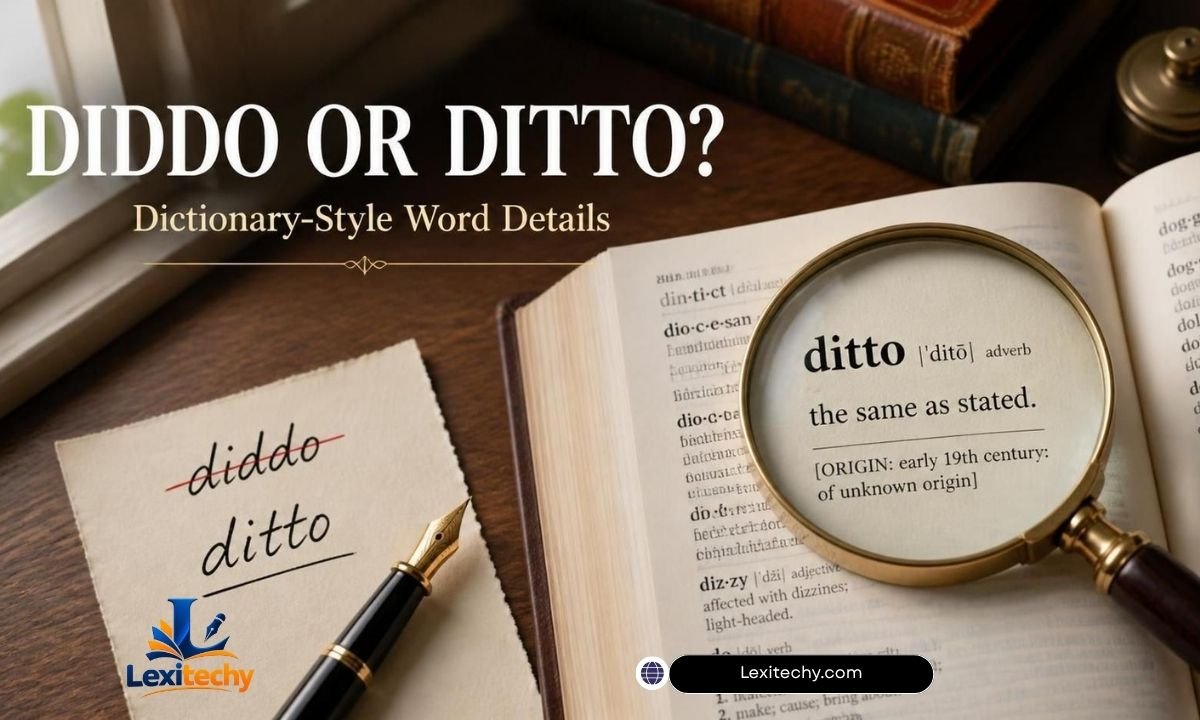
Dictionaries treat ditto as a flexible word that can act as a noun, a verb, and an adverb. The sections below break down each use in plain terms, along with synonyms, history, and common phrases.
Verb
As a verb, ditto means to copy or repeat something. It is less common than the noun or the reply, but it exists. The past tense is “dittoed,” and the present participle is “dittoing.”
For example: “The teacher dittoed the worksheet for the whole class.” This older sense comes from the days when copies were made on duplicating machines, often called ditto machines.
Noun
As a noun, ditto means a duplicate or a copy of something. The plural is “dittos” or “dittoes.” In a list, a ditto is the mark that stands in for a repeated item.
Ditto also works as an adverb that means “likewise” or “as before.” This is the form people use when they reply “Ditto!” to agree with someone.
Synonyms
Many words and phrases can replace ditto, depending on the setting:
- the same
- likewise
- same here
- me too
- so do I
- as above
- ditto marks (in lists)
Each choice has a slightly different feel. “Same here” and “me too” are casual, “likewise” is more polite, and “as above” suits written documents.
Example Sentences
Here are more examples of ditto in everyday English:
- “I need a vacation.” “Ditto.”
- “Item one: blue pen. Item two: ditto.”
- “He ordered the same thing, ditto for his sister.”
- “My text just said, ‘Miss you,’ and she replied, ‘Ditto.'”
- “The form lists the address once, then ditto marks below it.”
Notice that each sentence relies on something earlier for its meaning. That is the core idea behind ditto.
Word History
Ditto comes from Italian, where the word “detto” or “ditto” meant “said.” The Italian form came from the Latin word “dictus,” the past participle of “dicere,” which means “to say.” This is the answer to “why is ditto spelled with a t”: the Latin root has a “t” sound, and the spelling kept it.
English borrowed the word in the 1600s, first in business and bookkeeping. Accountants used it to mean “the aforesaid” in lists of dates and amounts. Over time, it spread into everyday speech and took on its modern meaning of “the same.”
Phrases Containing
A few phrases with ditto are still in use:
- Ditto marks: the symbol (〃) or quotation marks used to show a repeated item in a list.
- Ditto that: a casual way to agree with someone.
- Ditto to you: a reply that returns a wish or greeting.
- Ditto for me: a way to say you want the same thing.
- Ditto machine: an old duplicating device once common in schools.
Frequently Asked Questions
What does ditto slang mean?
Ditto in slang means “same here” or “me too.” People use it to agree or return a feeling without repeating the whole sentence.
What does diddo mean in slang?
Diddo has no slang meaning of its own. It is simply a common misspelling of ditto, so readers should correct it.
What does ditto do mean?
“Ditto do” is not a standard phrase. People may mean “I do the same,” or they may be asking what the Pokémon Ditto does.
Is it okay to say Ditto?
Yes, it is fine in casual speech and texts. In formal writing or serious moments, choose “likewise” or a full sentence instead.
Is diddo a word?
No, diddo is not a word in standard English. The correct spelling is ditto, with two t’s.
Is ditto a real word?
Yes, ditto is a real word listed in all major dictionaries. It works as a noun, verb, and adverb.
What does ditto mean in a text message?
In a text, ditto means “same here” or “me too.” It is a quick way to agree or return a message like “miss you.”
Is ditto the same as “same”?
They are close, but not identical. Ditto is more casual and often serves as a short reply, while “same” is more flexible.
Final Words
The answer to diddo or ditto is simple: ditto is the correct spelling, and diddo is a common mistake. The error happens because ditto is often pronounced with a soft “d” sound in American English, and because the word is heard more often than it is written. Once you remember the Latin and Italian roots behind the “t,” the spelling becomes easier to keep straight.
Use ditto when you want a quick, friendly way to say “the same” or “me too.” Keep it for casual conversation and informal writing, and switch to “likewise” or a full sentence in formal settings. If you ever feel unsure, remember that there is only one right choice, and it has two t’s.

Emily Carter is an English content writer and SEO specialist with 5 years of experience in creating clear, helpful, and search-friendly content. She writes about grammar, word meanings, synonyms, vocabulary, and everyday English usage. Her goal is to make confusing words and language rules simple, practical, and easy to understand.


Pingback: Laid Off or Layed Off? Discover the Correct Spelling
Pingback: Matt or Mat? Discover the Correct Spelling and Usage in US English