
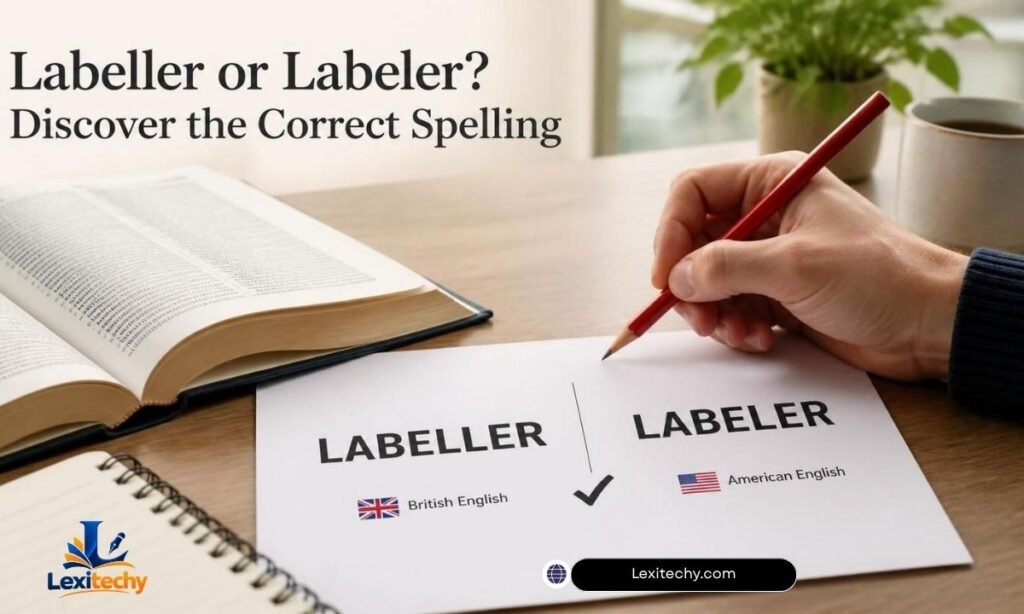
Have you ever typed a word, seen a red squiggly line, and wondered whether you made a mistake? That happens often with labeller or labeler, two spellings that look almost identical and appear in real writing every day. Readers want to know which one is right, and the honest answer depends on where the writing will be read. Choosing the wrong one can make a professional document look careless.
This article explains the difference between the British and American spellings, shows how each one works in a sentence, and covers related forms such as labeling and labelling. You will also find a short quiz, a list of common mistakes, and dictionary-style details. By the end, you will know which spelling to choose and why, so you can write with confidence in emails, reports, product descriptions, and school work.
Quick Answer
Both spellings are correct. Labeler is the standard American English spelling, and labeller is the standard British English spelling. They mean the same thing: a person, company, or machine that applies labels.
If your readers are in the United States, use labeler. If your readers are in the United Kingdom, Australia, or most other English-speaking countries outside North America, use labeller. Pick one and keep it consistent throughout your document.
Why People Confuse Them
The confusion comes from a long-running split between American and British spelling. Both versions are built from the same base word, “label,” plus the ending “-er,” which turns a verb into a noun for the person or thing doing the action. The only difference is whether the final L is doubled before the ending.
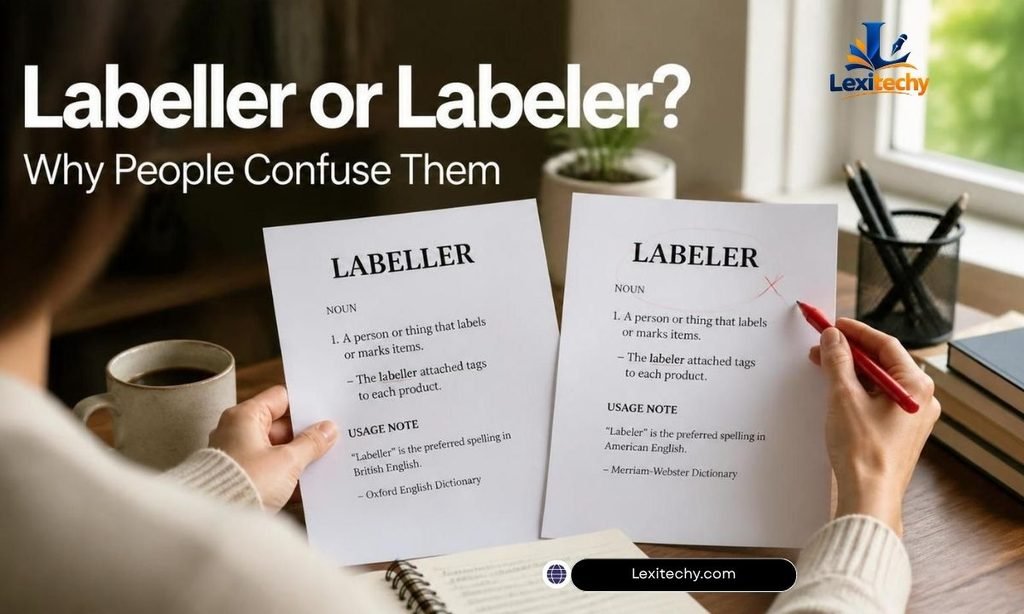
Spell checkers add to the problem. Many programs are set to a default language, so a British writer may see labeller flagged in a US-based program, and an American writer may see labeler flagged in a UK-based one. The software is not always wrong, but it is only checking against one regional standard.
Readers also meet both spellings online. Product listings, manuals, and international websites mix the two, so it is easy to assume one of them is a typo. In reality, each one is correct in its own region.
Key Differences At A Glance
A quick comparison makes the pattern easier to see. The table below shows the main forms of the word in both varieties of English.
| Form | American English | British English |
| Agent noun (person or machine) | labeler | labeller |
| Present participle | labeling | labelling |
| Past tense | labeled | labelled |
| Base verb and noun | label | label |
The rule behind this is simple. British English usually doubles a final L after a single vowel when adding an ending that starts with a vowel, even if the last syllable is not stressed. American English usually keeps the single L unless the last syllable is stressed.
The same pattern appears in many other words:
- travel, traveler (US) and traveller (UK)
- cancel, canceled (US) and cancelled (UK)
- model, modeling (US) and modelling (UK)
- level, leveled (US) and levelled (UK)
Meaning and Usage Difference
There is no difference in meaning between the two spellings. Labeler and labeller both describe someone or something that attaches a label to an object, package, document, or file. The only thing that changes is the regional spelling.
In everyday work, the word appears in several settings. In manufacturing and packaging, it can describe a machine that applies labels to bottles or boxes. In offices and shops, it can describe a hand-held tool or a person who tags products with prices. In technology, it can describe a person who tags images or text so a computer system can learn from them.
The word can also describe a company. In US drug listings, for example, the labeler is the company that markets a drug product under its own name. This usage is more specialized, but it follows the same spelling rule.
Tone, Context, and Formality
Neither spelling is more formal or more casual than the other. Both are standard words that fit equally well in a technical manual, a job posting, or a friendly email. What matters is whether the spelling matches the regional style of the document.
Formal documents often follow a style guide. A US company may follow the Associated Press Stylebook or the Chicago Manual of Style, which use American spelling. A UK publisher may follow the Oxford style or a house guide that uses British spelling.
Legal, scientific, and regulatory documents deserve extra care. If a form or regulation uses a specific spelling, such as a “labeler code” in US drug records, copy it exactly as written.
Which One Should You Use?
Choose the spelling that fits your audience, not your personal taste. For a US audience, labeler is the right choice. For readers in the UK, Australia, New Zealand, and many other countries, labeller is the better fit.
If your audience is mixed, pick the variety used by most of your readers and apply it everywhere. Canada is a special case. Canadian writing often follows American patterns for some words and British patterns for others, and many Canadian writers use labelled and labelling, so check your style guide when in doubt.
Consistency matters more than almost anything else. Do not use labeler in one paragraph and labeller in the next, and keep related words in the same style:
- labeler with labeling and labeled (American)
- labeller with labelling and labelled (British)
Labeller or labeler quiz
Test yourself with these five questions. The answers are listed below.
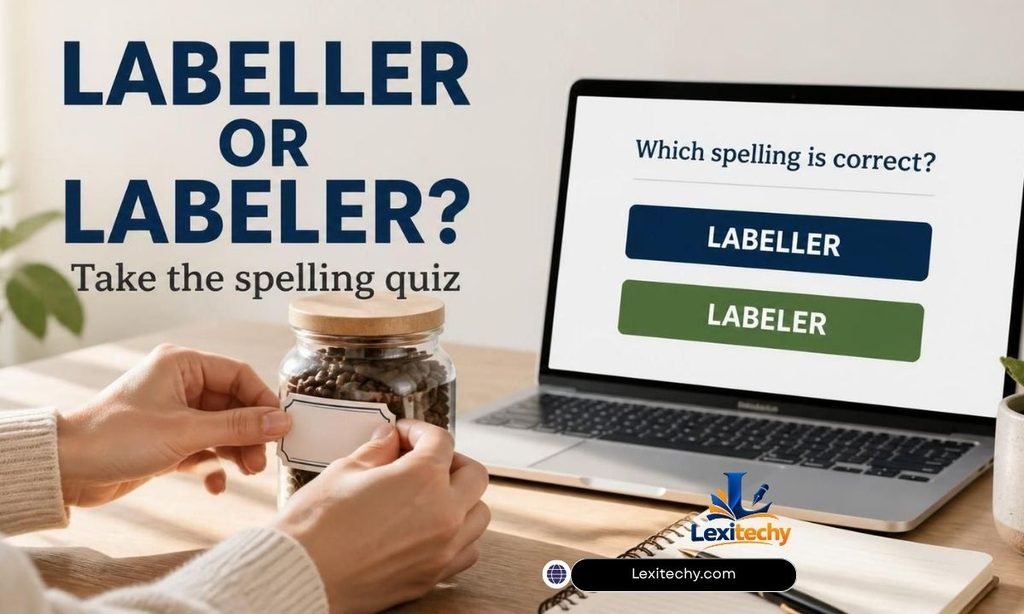
Question 1. You are writing a product page for a US shop. Which spelling should you use: labeler or labeller?
Question 2. You are writing a school essay in London. Which spelling of the past tense is standard: labeled or labelled?
Question 3. Which sentence is spelled in American English? “The labelling machine broke down.” or “The labeling machine broke down.”
Question 4. True or false: labeler and labeller have different meanings.
Question 5. Which pair is consistent British spelling: “labeller and labelling” or “labeller and labeling”?
Answers:
- Labeler. It is the American spelling.
- Labelled. It is the British spelling.
- “The labeling machine broke down.” It uses one L.
- False. They mean the same thing and differ only in regional spelling.
- “Labeller and labelling.” Both use the double L.
When One Choice Sounds Wrong
Sometimes a spelling simply looks wrong to you, even though it is correct. An American reader may see labeller and assume it is a typo, while a British reader may see labeler and think a letter is missing. This reaction is a matter of habit, not grammar.
The problem becomes real when the spelling clashes with the rest of the page. A US business report that uses “color,” “organize,” and “labeller” looks mixed. A UK report that uses “colour,” “organise,” and “labeler” has the same issue.
When a spelling feels odd, check it against the rest of your text. If the surrounding words follow one regional style, the labeler or labeller spelling should follow the same style.
Common Mistakes (and Quick Fixes)
Most errors with this word come from mixing styles or applying a rule only halfway. Here are the mistakes readers see most often, along with simple fixes.
- Mixing regions in one document. Writing “labeler” and “labelling” together is inconsistent. Fix it by choosing American (labeler, labeling) or British (labeller, labelling) and applying it throughout.
- Assuming one spelling is wrong. Neither is a mistake. Both are correct in their own region.
- Trusting the spell checker blindly. Check the language setting of your software before accepting or rejecting a suggestion.
- Forgetting related words. If you change labeler to labeller, also change labeling to labelling and labeled to labelled.
- Using the wrong spelling for a regulated term. Official names and codes should be copied exactly as they appear in the source.
A simple habit helps. Before you publish, search your document for “label” and read each form once to confirm it matches your chosen style.
Everyday Examples
Seeing the word in a sentence makes the rule easier to remember. The examples below show both spellings in typical situations.
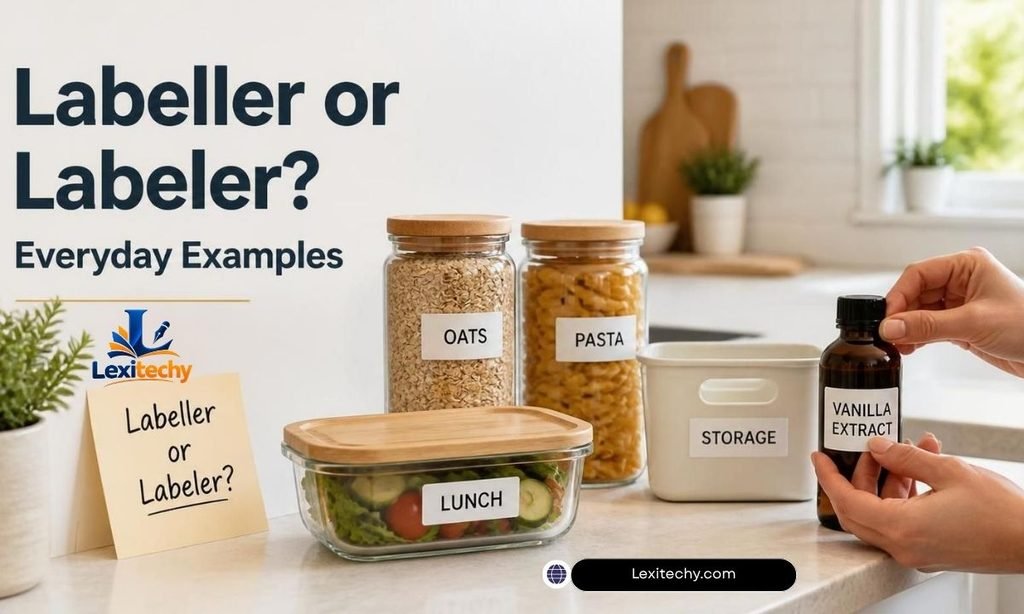
American English:
- The labeler at the warehouse checks every box before it ships.
- A new bottle labeler can apply hundreds of stickers per minute.
- She worked as a data labeler for an image recognition project.
British English:
- The labeller at the warehouse checks every box before it is dispatched.
- A new bottle labeller can apply hundreds of stickers per minute.
- He worked as a data labeller for an image recognition project.
Notice that only the spelling changes. The grammar, meaning, and sentence structure stay the same, and the same pattern holds for labeling and labelling.
Dictionary-Style Word Details
The details below follow a dictionary layout for quick reference. They cover the main forms of the word, along with its history and common phrases.
Verb
The verb form is label, which is spelled the same in both American and British English. Its other forms differ by region.
- American: label, labels, labeled, labeling
- British: label, labels, labelled, labelling
Example: “Please label each jar with the date.” In the past tense, “She labeled each jar” is American and “She labelled each jar” is British.
Noun
As a noun, labeler (American) or labeller (British) means a person, company, or machine that applies labels. In some technical fields, it can also mean a person who tags data, such as images or text, with descriptive categories.
The base noun “label” means a tag, sticker, or piece of paper attached to an item to identify it or give information. This noun is spelled the same everywhere.
Synonyms
Depending on the situation, several words can replace labeler or labeller:
- tagger
- marker
- stamper
- label applicator
- labeling machine (or labelling machine)
- annotator (especially for data work)
These words are not perfect matches in every case. “Annotator,” for example, usually refers to data work, while “label applicator” usually refers to equipment.
Example Sentences
- The labeler pressed the trigger and placed a price tag on each can. (American)
- The new labeller saves the team hours of manual work every week. (British)
- A reliable labeler should handle both small and large packages. (American)
- Our data labellers reviewed thousands of images last month. (British)
Word History
The word “label” entered English during the Middle English period. It came from Old French and originally referred to a narrow strip of cloth or parchment. Over time, it came to mean a slip attached to an object to identify it.
The verb use, meaning to attach a label or to describe something with a word or phrase, developed later. The ending “-er” is a very old English suffix used to name the doer of an action, which is how labeler and labeller were formed. The split in spelling developed as American and British writers settled on different habits for doubling consonants.
Phrases Containing
- price labeler (or price labeller)
- bottle labeler (or bottle labeller)
- data labeler (or data labeller)
- labeler code, used in US drug listings
- labeling machine operator (or labelling machine operator)
- hand-held labeler
For the last phrase, the correct spelling of a labeling machine operator is “labeling” in American English and “labelling” in British English.
FAQs
Is it labeller or labeler?
Both are correct. Labeler is the American spelling, while labeller is used in British English. Choose the one that matches your audience.
What is a labeler?
A labeler is a person or machine that attaches labels to products, packages, or data. It is the standard American spelling.
How do you spell labeller?
Spell it L-A-B-E-L-L-E-R, with two Ls before the ending. This is the British spelling, also common in Australia.
How do you spell “labeling” in the UK?
In the UK, labeling is written as labelling, with a double L. The American version uses just one L.
Is labeled or labelled correct?
Labeled is American and labelled is British. Both are past tense forms of label, so match the spelling to your audience.
Final Thoughts
The choice between labeller or labeler comes down to region, not right and wrong. Labeler is the American spelling, and labeller is the British spelling. Neither one is a mistake, and neither one is more formal than the other. Both mean a person, company, or machine that applies labels, and the same pattern applies to labeling and labelling, and to labeled and labelled.
Your takeaway is simple. For a US audience, use labeler. Decide who your readers are, choose the matching spelling, and use it consistently across your whole document. Before you publish, check your spell checker’s language setting and review related words so everything matches. With that small step, your writing will look polished and correct to readers on either side of the Atlantic. If you are ever unsure, return to the quick answer and the table near the top of this article.

Emily Carter is an English content writer and SEO specialist with 5 years of experience in creating clear, helpful, and search-friendly content. She writes about grammar, word meanings, synonyms, vocabulary, and everyday English usage. Her goal is to make confusing words and language rules simple, practical, and easy to understand.


Pingback: Optimize vs. Optimise: Discover the Correct Spelling