
Have you ever typed a sentence about a funny friend and then stopped to wonder, humour or humor? Maybe your spellchecker underlined one version, a teacher once marked your choice wrong, or you spotted the other on a British website and assumed someone made a typo. You are not alone, because both spellings look right and both appear in books, websites, and emails every day.
This article answers a simple question: which spelling is correct? You will learn which one belongs in American English and which one belongs in British English, how the word is used, and how to avoid common slips in school, work, and everyday writing. You will also find example sentences, pronunciation notes, a short word history, and quick answers to common questions, so you can choose the right spelling for your readers with confidence.
Quick Answer
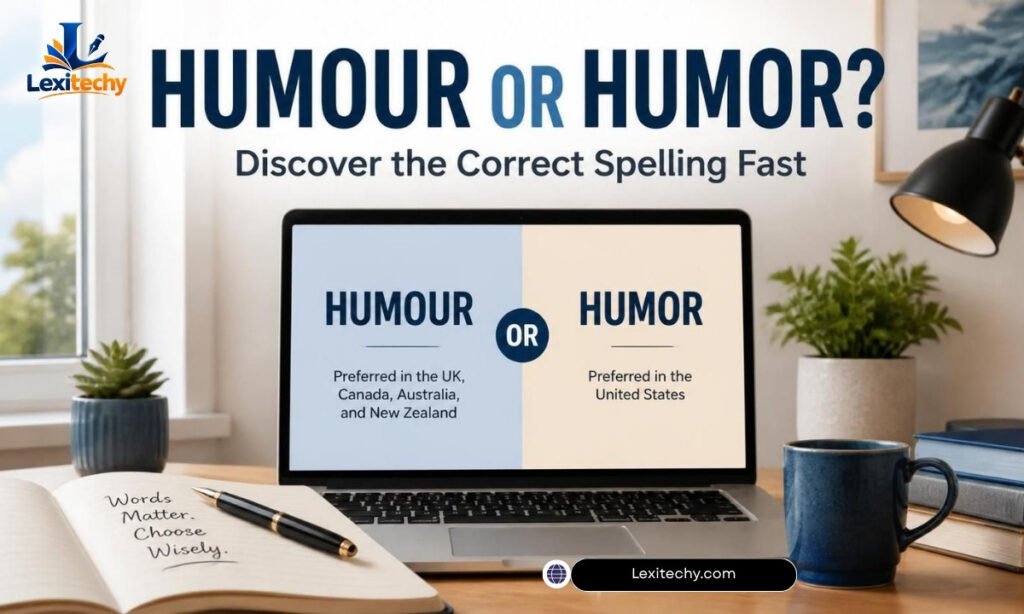
Both spellings are correct, but they belong to different varieties of English. “Humor” is the standard American spelling of humor, and “humour” is the standard British spelling of humour. The meaning is the same.
If you are writing for readers in the United States, use “humor.” If you are writing for readers in the UK, Canada, Australia, New Zealand, or India, “humour” is the usual choice. Whichever you pick, use it consistently in the same piece of writing.
Why People Confuse Them “Humour or Humor”
Humour or Humor are separated by a single letter, so it is easy to doubt which one is right. They also sound almost identical, which gives your ear no clue about the spelling. Spellcheck tools add to the confusion because they may flag one version or the other depending on the language setting.
The confusion also comes from a wider pattern. Many English words end in “-our” in British English and “-or” in American English, such as “color” and “colour.” Because readers see both versions online, the difference can feel random, even though it follows a clear rule.
Key Differences At A Glance
Here is a quick Humour or Humor comparison:
| Feature | Humor | Humour |
| English variety | American English | British English |
| Used in | United States | UK, Canada, Australia, New Zealand, India |
| Verb forms | humor, humored, humoring | humour, humoured, humouring |
| Adjective | humorous | humorous |
| Meaning | Same | Same |
| Typical US pronunciation | HYOO-mer | Not applicable |
| Typical UK pronunciation | Not applicable | HYOO-muh |
Notice that the adjective “humorous” is spelled the same way in both varieties. The extra “u” appears only in the base word and its direct verb forms.
Spelling Rules: -Our vs -Or Words
The Humour or Humor spelling rules are part of a larger family. British English kept the “-our” ending that came from French, while American English simplified many of these words to “-or.” Here are common pairs:
- color / colour
- favorite / favourite
- neighbor / neighbour
- honor / honour
- labor / labour
- flavor / flavour
Not every word follows the pattern. Words like “governor,” “actor,” and “error” use “-or” in both varieties. If you know the rule for one pair, you can usually apply it to the rest.
Meaning and Usage Difference
There is no difference in meaning. The humour meaning in English and the humor meaning in English are identical: the quality of being funny, the ability to notice or enjoy what is funny, or a person’s mood. Only the spelling changes by region.

The usage is also the same. You can talk about a “sense of humor” or a “sense of humour,” a “dry wit,” or a “playful mood.” As a verb, it means to go along with someone’s wishes to keep them happy, as in “She humored her little brother and played the game again.”
Tone, Context, and Formality
Neither spelling is more formal or more casual than the other. The tone comes from the words around it, not from the number of letters. “Gallows humor” sounds dark, while “good humor” sounds warm, and that is true in both varieties.
In formal writing, follow the style guide your audience expects. American style guides such as AP and Chicago use “humor.” British style guides, including those used by many UK publishers, use “humour.” The right choice is about matching your reader, not about being more polished.
Which One Should You Use?
The simplest rule is to match your audience. Ask where most of your readers live, then choose the spelling they see in everyday writing. Here is a quick guide:
- Readers in the USA: use “humor.”
- Readers in the UK: use “humour.”
- Readers in Canada, Australia, or New Zealand: use “humour.”
- Mixed or global readers: choose the spelling that matches your largest group and stay consistent.
Names are an exception. If a magazine, company, or book title uses “Humour,” keep that spelling when you refer to it directly, even in an American article.
I like your Humour or Humor
This phrase is a good test case. In a message to an American friend, you would write, “I like your humor.” In a message to a friend in London or Toronto, you would write, “I like your humour.” Both are correct for their audiences.
Many people also say, “I like your sense of humor,” which sounds a little more natural in everyday speech. The spelling rule stays the same. Pick the spelling that fits the reader and avoid switching halfway through a conversation or document.
When One Choice Sounds Wrong
A reader may think a perfectly correct spelling is a mistake. An American reader who sees “humour” may assume it is a typo or an old-fashioned style. A British reader who sees “humor” may think the writer is using American spelling without realizing it.
The fix is easy. Check your audience, then set your word processor to the matching language, such as English (US) or English (UK). This helps your spellcheck catch mismatches before your readers do.
Common Mistakes (and Quick Fixes)
Most errors with Humour or Humor come from mixing the two varieties. Here are the ones to watch for:
- Mixing spellings in one piece. Writing “humor” and “colour” together looks inconsistent. Fix: choose one variety for the whole text.
- Spelling the adjective “humourous.” The correct spelling is “humorous” in both American and British English.
- Using “humoured” in US writing. In American English, write “humored.”
- Calling one spelling wrong. Both are correct in the right context.
- Changing a proper name. If a title uses “Humour,” keep it as written.
A quick proofreading pass for “-our” and “-or” words can catch most of these problems.
Everyday Examples
You will see this word in many ordinary places. In a US job application, you might write, “I bring a good sense of humor to the team.” In a UK email, the same line would read, “I bring a good sense of humour to the team.”
Social media captions, school essays, and product reviews follow the same pattern. A US review might say, “The comedy’s dry humor made me laugh,” while a UK review might say, “The comedy’s dry humour made me laugh.”
Humour or humor in a sentence
Here are examples of humor in a sentence for American English:
- Her humor made the long meeting easier to sit through.
- He kept his good humor even after the delay.
- The show relies on gentle humor rather than loud jokes.
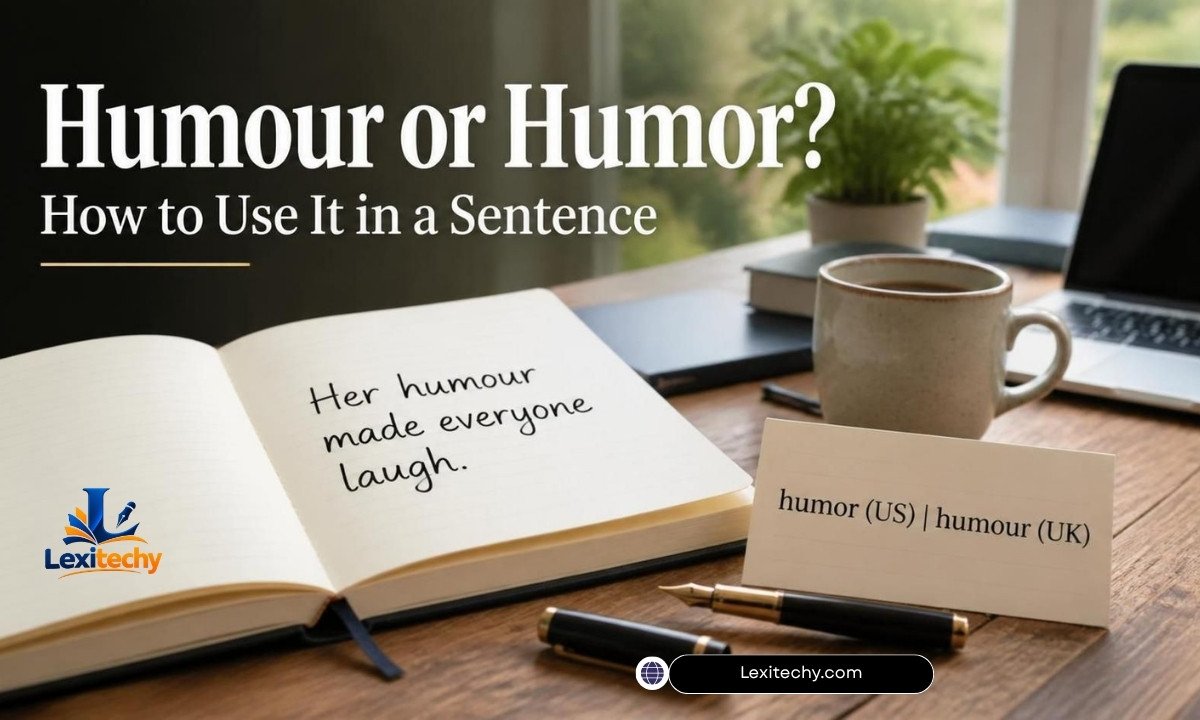
Here are examples of humour in a sentence for British English:
- Her humour made the long meeting easier to sit through.
- He kept his good humour even after the delay.
- The show relies on gentle humour rather than loud jokes.
Dictionary-Style Word Details
Dictionaries list the same senses for both spellings. The details below use “humor” first, with the British spelling shown where it differs.
Verb
To humor someone means to go along with their wishes or moods so they stay content. The verb forms are humor, humors, humored, and humoring in American English. British English uses humour, humours, humoured, and humouring.
Noun
As a noun, humor can mean the quality of being funny, the ability to find things funny, or a person’s mood or temper. For example, “in good humor” means in a cheerful mood. In older medical language, it also meant one of the four fluids of the body.
Synonyms
The humor synonyms and related words list includes wit, comedy, funniness, amusement, playfulness, and levity. For mood, related words include temper, spirits, and disposition. The humour synonyms and related words are the same, since only the spelling differs.
Humour or humor pronunciation
The spelling difference does not change the sound much. In American English, the word is usually pronounced HYOO-mer, and some speakers drop the “h” and say YOO-mer. In British English, it is usually HYOO-muh, with no strong “r” sound at the end.
Example Sentences
- She humored him by listening to the whole story again. (US)
- She humoured him by listening to the whole story again. (UK)
- His humor is quiet but sharp. (US)
- His humour is quiet but sharp. (UK)
Word History
The word comes from the Latin “humor,” meaning fluid, and entered English through Old French “humour.” Ancient and medieval medicine taught that four body fluids, called humours, shaped a person’s mood and personality. Over time, the word came to mean a person’s temper, and later the ability to be funny.
British English kept the French-style “-our” ending. In the early 1800s, the American lexicographer Noah Webster promoted simpler spellings, and “humor” became standard in the United States. That is why British English uses “humour” and American English uses “humor.”
Phrases Containing
- sense of humor / sense of humour
- good humor / good humour
- out of humor / out of humour
- dry humor / dry humour
- dark humor / dark humour
- gallows humor / gallows humour
- humor me / humour me
FAQs About Humour or Humor
How do you spell good humor?
In American English, it is “good humor.” In British English, it is “good humour.” Both describe a cheerful, pleasant mood.
How do the British spell humour?
The British spell it h-u-m-o-u-r, with a “u” before the “r.” Canada, Australia, and New Zealand use the same spelling.
Are humor and humour the same?
Yes. They mean the same thing and sound nearly alike. “Humor” is the American spelling, and “humour” is the British spelling.
What is a comedy of humour?
A comedy of humours is an English Renaissance play style where each character is driven by one dominant trait, made famous by Ben Jonson.
Final Thoughts
So, which spelling is right? Both are correct, neither is better, and the choice depends on your audience. Use “humor” for readers in the United States and “humour” for readers in the UK and most Commonwealth countries. The meaning, tone, and use of the word stay the same in either case. The difference comes from history, since British English kept the French-style ending and American English simplified it in the 1800s.
When you face the question of humour or humor again, remember three quick checks. Match your audience, stay consistent from start to finish, and spell the adjective “humorous” everywhere. Keep proper names and titles exactly as published, and proofread other “-our” and “-or” words in the same pass. Set your spellcheck to the right language, and you can write with confidence, knowing your readers will understand you either way.

Emily Carter is an English content writer and SEO specialist with 5 years of experience in creating clear, helpful, and search-friendly content. She writes about grammar, word meanings, synonyms, vocabulary, and everyday English usage. Her goal is to make confusing words and language rules simple, practical, and easy to understand.


Pingback: Signup or Sign Up? Discover the Correct Spelling Fast