

Have you ever stared at a button that says “Sign Up” and wondered if your own website should say “Signup” instead? Signup or sign up is one of the most common spelling questions in online writing, because both forms look natural and both appear on countless websites, apps, and forms. The confusion makes sense, since English often turns two-word verbs into one-word nouns over time.
This guide explains what each form means, when to use it, and how plurals, hyphens, and past tense work. You will find clear example sentences, a comparison table, and quick memory tips for buttons, forms, and registration pages. We also cover common mistakes so you can proofread with confidence. By the end, you will know which spelling fits your sentence and your website.
Quick Answer
Use sign up (two words) when you mean the action. It is a verb phrase: “Please sign up for the newsletter.”
Use sign-up (hyphenated) or signup (one word) when you need a noun or an adjective: “The sign-up was quick” or “Fill out the signup form.” Dictionaries usually prefer the hyphen, while many tech brands use one word. Pick one style and stay consistent.
Signup or Sign Up Free
A call to action like “Sign up free” is a command, so it takes two words. Here, sign up is a verb, and free tells readers there is no cost.
If you name the offer instead of giving a command, you need a noun form: “Enjoy a free sign-up” or “Start your free signup today.”
Meaning and Definition of Each Word (Signup or Sign Up)
Signup or Sign Up relate to joining something, but they do different jobs in a sentence. The sign up definition is to add your name to a list, class, service, or account. The signup definition is the act or result of doing that, or a word that describes it.
1. Sign Up
Sign up is a phrasal verb meaning to enroll, register, or agree to join. It is often followed by “for”: sign up for a class, sign up for an account.
2. Signup
Signup works as a noun (“Signups opened Monday”) or an adjective (“the signup page”). The hyphenated sign-up is the traditional dictionary spelling, and signup is a widely used variant.
Sign Up Login
Sign up and log in are different actions. You sign up to create a new account, and you log in to open an existing one. The noun form is login: “Enter your login details.”
Mixing them confuses users. A button labeled “Sign up” suggests a new account, while “Log in” suits returning visitors.
Key Differences Between Signup or Sign Up
The main difference is the part of speech. Here is a quick way to separate Signup or Sign Up:

- Sign up (two words): a verb that describes an action.
- Sign-up or signup: a noun or adjective that names or describes a thing.
- Verb endings: only the verb changes form (signs up, signed up, signing up).
- Noun endings: only the noun takes a plural (sign-ups or signups).
If you can add “-ed” or “-ing” to the word, you almost always need the two-word verb.
Signups or Sign-Ups: Which Spelling Is Correct?
Both are acceptable plurals for the noun. Sign-ups follows the dictionary style, and signups matches the one-word style common in technology writing. Choose one and keep it.
Avoid “sign ups” as a noun, and never write “signs up” for the plural. “Signs up” is only a verb: “She signs up every year.” A correct noun example is: “We had 200 sign-ups this week.”
Comparison Table
| Form | Part of Speech | Example |
| sign up | Verb phrase | “Sign up for the workshop.” |
| signed up | Past tense verb | “He signed up yesterday.” |
| signing up | Verb (-ing form) | “I am signing up now.” |
| sign-up | Noun or adjective | “The sign-up closes Friday.” |
| signup | Noun or adjective | “Use the signup form.” |
| sign-ups / signups | Plural noun | “Sign-ups doubled this month.” |
Signup or Sign In
Sign in and sign up are not interchangeable. Sign in means to access an account you already have, and the noun form is sign-in: “Click the sign-in page.” Sign up means to create something new.
Sign in and log in mean nearly the same thing. The key sign in vs sign up rule is simple: in is for returning users, and up is for new ones.
Examples in Sentences
Seeing the words in context makes the rule easier to remember. These sign up example sentences and signup example sentences show each use.
Using Sign Up (Verb)
- “You can sign up for the course online.”
- “They signed up for the newsletter last week.”
- “I am signing up my daughter for soccer.”
- “Why did you sign up for an account?”
Using Signup (Noun/Adjective)
- “The signup form takes two minutes.”
- “Our newsletter signup page is live.”
- “The sign-up was easier than I expected.”
- “Sign-ups for the event open on Monday.”
Signup or Sign Up Gmail
People sign up for an account with an email provider like Gmail. That is a verb, so it takes two words. The page where you do it can be called the Gmail signup page, which is an adjective use.
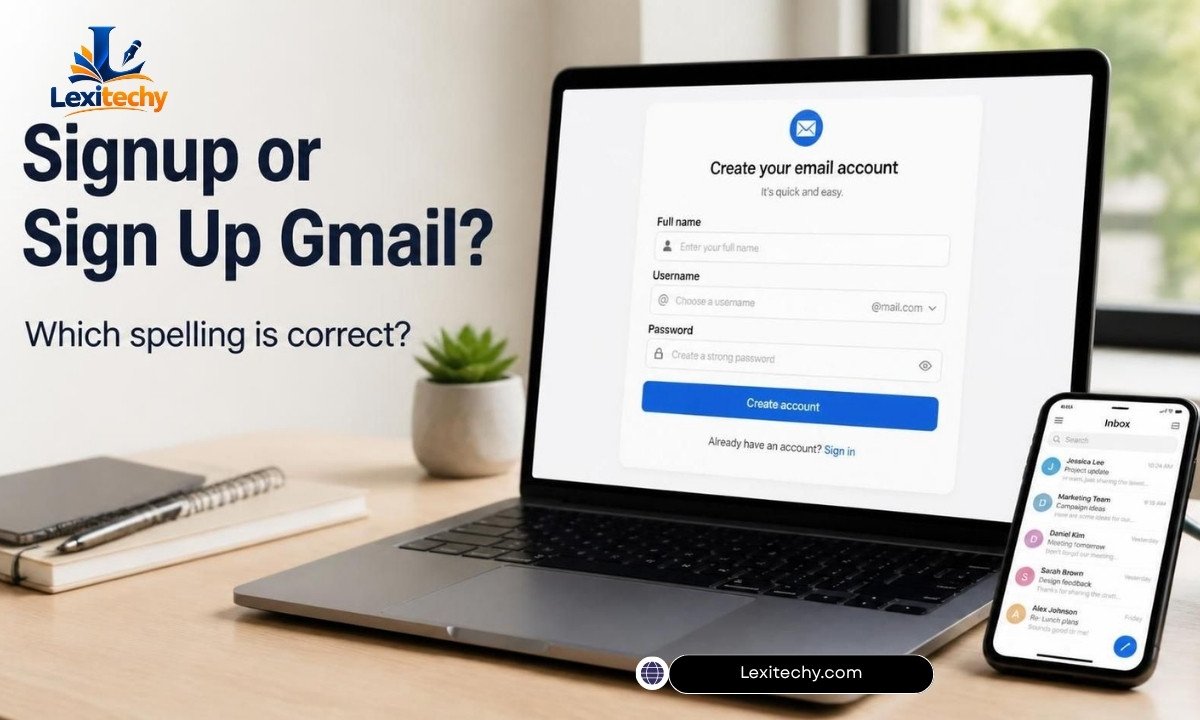
Button labels on screens may say “Create account” or “Sign up.” Interface text follows each company’s choices, so it is not a grammar rule for your own writing.
Sign Up Link
A link that reads “Sign up” is a command, so it stays two words. When you refer to the link itself, use the noun form: “Click the sign-up link in the email.”
The same logic applies to buttons. Write “Sign up” on the button, but call it the “sign-up button” or “signup button” in a help article.
Signup or Sign Up Online
Online writing uses both forms, so context decides. Use two words for actions (“Sign up online in two minutes”) and the noun form for things (“Complete the online signup form”).
Developers often write “signup” in code, such as a file named signup.html. That is a naming habit, not a grammar rule for regular sentences.
Signup or Sign Up Genius
SignUpGenius is a well-known online tool for creating sign-up sheets, often used by schools and volunteer groups. As a brand name, it follows the company’s own spelling and capitalization.
In everyday writing, you would still say you “sign up” for a volunteer slot. The brand spelling does not change the verb rule.
Common Mistakes
These common spelling mistakes appear often in emails, menus, and web pages:
- Writing “Please signup today” instead of “Please sign up today.”
- Writing “The sign up is open” instead of “The sign-up is open.”
- Using “signed-up” or “signupped” for the past tense. The correct form is signed up.
- Writing “signs up” for the plural noun instead of sign-ups.
- Switching between sign-up and signup on the same page.
Tips to Remember the Difference
Try the verb phrase vs noun test. If you can swap in “enroll” or “register,” write two words. If you can swap in “registration,” use sign-up or signup.
Another trick is to check for “the” or “a” before the word. “The sign-up” needs a noun form, while “to sign up” needs the verb. Finally, if you can add “-ed” or “-ing,” keep the words apart.
Signup Genius
Brand names like Signup Genius show why the one-word spelling feels so familiar. Popular products shape how people write everyday words, and many apps use “signup” in their menus.
Even so, brand style is not a general rule. Follow a brand’s spelling when you name the brand, and follow standard grammar the rest of the time.
Is Sign Up Hyphenated?
The verb is never hyphenated. You always write “sign up” as two words, as in “I will sign up tomorrow.”
For the noun and adjective, the hyphenated sign-up is the traditional choice in most dictionaries. The one-word signup is common in tech writing and product design. Check your publication’s style guide if you write for a specific outlet.
When to Use Each Word (Signup or Sign Up)
Use this quick guide when you are unsure:
- Sign up: when someone is performing the action.
- Sign-up: when you need a noun or adjective in formal or editorial writing.
- Signup: when your brand or style guide prefers one word.
- Sign-ups or signups: when you mean more than one registration.
Grammar Rules
These sign up grammar rules cover most situations:
- The verb is two words: sign up.
- The noun and adjective are hyphenated or one word: sign-up or signup.
- The past tense is signed up, and the continuous form is signing up.
- The third-person singular is signs up.
- The plural noun is sign-ups or signups.
- Use “for” after the verb when naming what you join: sign up for a class.
Sign Up or Sign Up Sheet
A sign-up sheet is a list where people add their names to join an event, shift, or activity. The hyphen shows that sign-up describes the sheet.
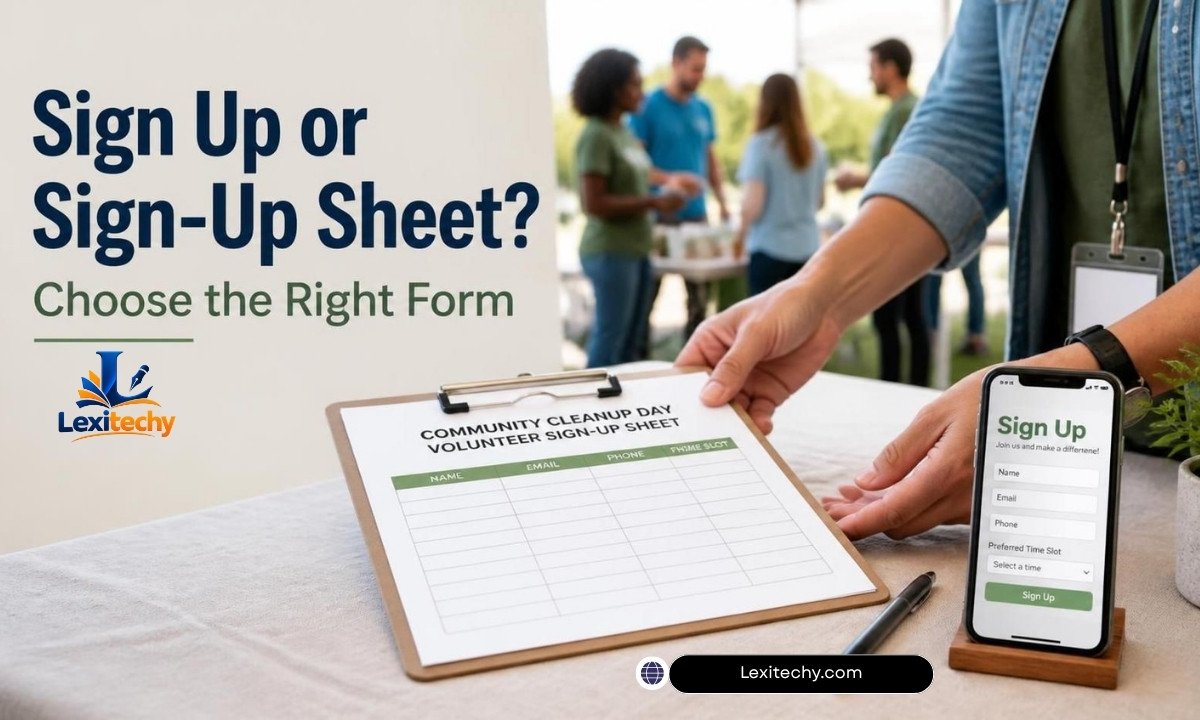
You will also see “signup sheet” and “sign up sheet.” The first is fine in one-word style, but the second is less precise because “sign up” is a verb here.
Synonyms or Related Words
Several words overlap with sign up, but each has a slightly different feel:
- Register: more formal, often used for events, voting, and official records.
- Enroll: common for schools, courses, and programs.
- Subscribe: used for ongoing content, such as newsletters and channels.
- Create an account: the specific step of making a profile on a website.
- Join: a general word for becoming a member.
FAQs About Signup or Sign Up
Which is correct, signup or sign up?
Both can be correct. Use “sign up” as a verb and “sign-up” or “signup” as a noun or adjective.
Is signup a single word?
Yes, as a noun or adjective, such as “signup form.” As a verb, always write two words: sign up.
What does “signup” mean?
Signup means the act of registering for something, or describes related items, like a signup page, form, or process.
Is signup correct?
Yes, it is widely accepted, especially in tech writing. Many dictionaries prefer the hyphenated sign-up, so follow your style guide.
Should I write “sign up” or “sign-up” on a button?
Use “Sign up” on a button because it is a command. Use “sign-up” when naming the button or page in text.
What is the past tense of sign up?
The past tense is “signed up.” Forms like “signupped” or “signed-up” as a verb are incorrect.
Conclusion
The rule is simple once you separate action from object. Use sign up as two words when someone is doing something, such as joining a list, a class, or an account. Use sign-up or signup when the word names a thing or describes another noun, such as a sign-up sheet, a signup form, or last week’s sign-ups.
Dictionaries lean toward the hyphen, while many tech teams prefer one word, so choose a style and apply it everywhere. Remember that signed up and signing up are the verb forms, and “signupped” is never correct. Next time the signup or sign up question comes up, test the sentence: if it is an action, use two words. That quick check keeps your emails, buttons, and web pages clear and consistent.

Emily Carter is an English content writer and SEO specialist with 5 years of experience in creating clear, helpful, and search-friendly content. She writes about grammar, word meanings, synonyms, vocabulary, and everyday English usage. Her goal is to make confusing words and language rules simple, practical, and easy to understand.
