
You are finishing a report, an invoice, or a school essay, and you stop on one word. Does it have one L or two? Totalling or totaling looks like a tiny choice, but it can make a careful writer doubt an entire sentence. Spell-checkers add to the confusion because they sometimes flag one form and accept the other, and online answers often contradict each other.
Both spellings are real, and neither one is a typo. The difference comes from regional spelling rules, not from meaning. This article shows which form belongs in American and British English, how the word works in everyday sentences, and which mistakes to avoid. By the end, you will know which spelling to choose, why it is correct, and how to keep your writing consistent from start to finish.
Quick Answer
In American English, the correct spelling is totaling (with one L), and the past tense is totaled. In British English, the correct spelling is totalling (with two Ls), and the past tense is totalled. Both forms mean exactly the same thing.
If you are writing for a US audience, use totaling. If you are writing for readers in the UK, Australia, Canada (in many cases), or most Commonwealth countries, totalling is the safer choice. The key is to pick one and stay with it.
Why People Confuse Them
The confusion starts with the base word. The verb “total” ends in a single L, and English has a habit of doubling final consonants before endings like -ing and -ed. Think of “run” becoming “running” or “stop” becoming “stopped.” Because of this pattern, many writers feel that a second L must be needed.
The second reason is that British and American English follow different rules for words that end in L. British spelling usually doubles the L when the last syllable is not stressed. American spelling usually does not. So the same word can look correct to one reader and wrong to another, even though both are following a rule.
Key Differences At A Glance
Here is a simple comparison of the two spellings:
| Form | American English | British English |
| Present participle | totaling | totalling |
| Past tense | totaled | totalled |
| Third person | totals | totals |
| Base verb | total | total |
Only the forms that add -ing or -ed change. The base word, the noun, and the third-person form (totals) are the same everywhere. This is the same pattern you see in other word pairs:
- traveling (US) and travelling (UK)
- canceling (US) and cancelling (UK)
- modeling (US) and modelling (UK)
- labeled (US) and labelled (UK)
If you already know one of these pairs, you already know the rule for totalling vs totaling.
Meaning and Usage Difference
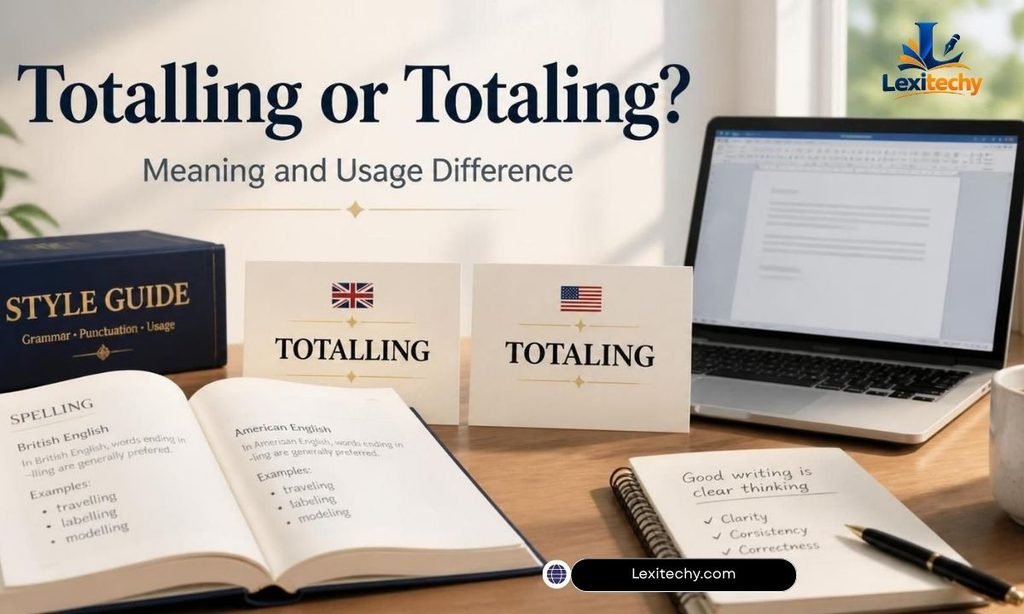
There is no difference in meaning between the two spellings. Both come from the verb “total,” and both can be used in the same situations. The only thing that changes is the regional spelling.
The verb has four main uses. Each example below shows the American spelling first, with the British spelling noted where it differs.
1. To Add Numbers Together
The most common use is to add up a list of numbers. This is the sense people usually mean when they say “adding up” or “totaling up” a bill.
- She spent the evening totaling the receipts. (UK: totalling)
- He totaled the column twice to make sure it was correct. (UK: totalled)
2. To Reach a Specific Amount
The verb can also mean that something adds up to a certain amount. In this sense, the subject is the thing being counted.
- Donations totaling $5,000 arrived last week. (UK: totalling)
- The repairs totaled more than the car was worth. (UK: totalled)
3. To Equal a Final Quantity
This use is close to the one above, but it often appears in news and business writing. It describes a final figure after everything has been counted.
- Attendance totaled 12,000 across the three days. (UK: totalled)
- Sales are totaling $2.4 million this quarter. (UK: totalling)
4. To Render a Vehicle a Total Loss
In informal speech, “to total” a car means to damage it so badly that it cannot be repaired economically. Insurance companies use this idea when they declare a vehicle a total loss.
- He totaled his car in the storm. (UK: totalled)
- The insurer totaled the truck after the flood. (UK: totalled)
This sense is more common in American English, but British speakers use it too, usually with the spelling totalled.
Read Now : Laid Off or Layed Off?
Tone, Context, and Formality
Spelling choice is mostly about audience, not about how formal your writing is. Both forms are acceptable in serious writing as long as they match the rest of the document. What matters is that your reader sees a consistent style.
In American English
American dictionaries list totaling and totaled as the standard forms. Style guides used in US schools, newsrooms, and businesses follow the same rule. If you write for a US reader and use totalling, it may look like a British spelling or a typo.
In British English
British dictionaries list totalling and totalled as the standard forms. UK publishers, schools, and government sites follow this pattern. A British reader may think totaling looks incomplete.
Formal Writing
In essays, reports, contracts, and academic papers, follow the style guide that applies to you. If no guide is given, choose the spelling that fits your audience and keep it the same throughout. If a sentence feels crowded with “total” forms, you can also use “adding up” or “the sum of” instead.
Informal Writing
In emails, texts, and social posts, readers are more relaxed about regional spelling. Even so, it is a good habit to use the form you would use in a formal document. That way, you never have to think about it twice.
Which One Should You Use?
Use the spelling that matches your readers. For an American audience, choose totaling and totaled. For a British, Irish, Australian, or New Zealand audience, choose totalling and totalled.
If your readers come from several countries, pick one standard and apply it to the whole document. Many international companies set a style guide for exactly this reason. A simple rule helps: if the rest of your text says “color,” use totaling. If it says “colour,” use totalling.
When One Choice Sounds Wrong
Sometimes a spelling looks odd simply because you are not used to it. An American reader may pause at “totalling,” and a British reader may pause at “totaling.” That reaction is about habit, not about correctness.
If you are not sure, check the spelling of other words in the same text. Words such as “center,” “favor,” and “organize” point to American English. Words such as “centre,” “favour,” and “organise” point to British English. Match the pattern, and the right form of total will follow.
Common Mistakes (and Quick Fixes)
Most errors with this word come from a handful of habits. Here are the five most common, with simple fixes.
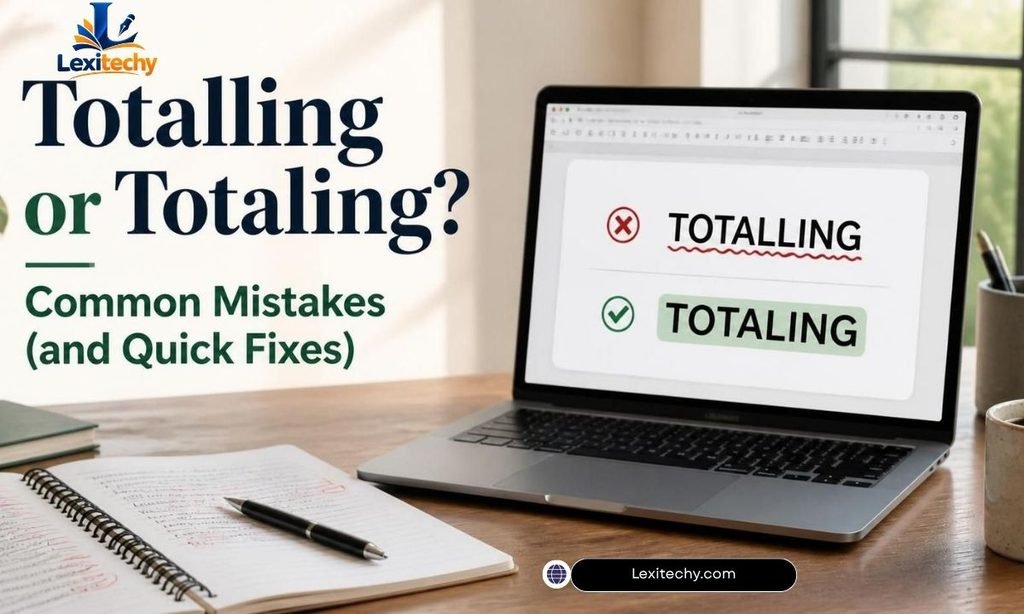
Mistake #1: Assuming One Form Is Wrong
Many writers believe that only one spelling is correct everywhere. In fact, both are correct in their own regions. Fix: Check your audience before you change anything.
Mistake #2: Mixing Regional Styles
A text that uses “totaling” next to “colour” or “organise” looks inconsistent. Fix: Choose one regional style and apply it to every word that differs.
Mistake #3: Believing the Meaning Changes
Some people think totalling and totaling have different meanings, such as one for math and one for cars. They do not. Fix: Treat them as spelling variants of the same word.
Mistake #4: Overcorrecting
A writer who sees totalling in a British article may “fix” it to totaling, even though the article is correct for its audience. Fix: Only change a spelling when it does not match the intended style.
Mistake #5: Switching Mid-Document
It is easy to type totaled on page one and totalled on page ten, especially in long documents. Fix: Use a find-and-replace search at the end to catch every instance.
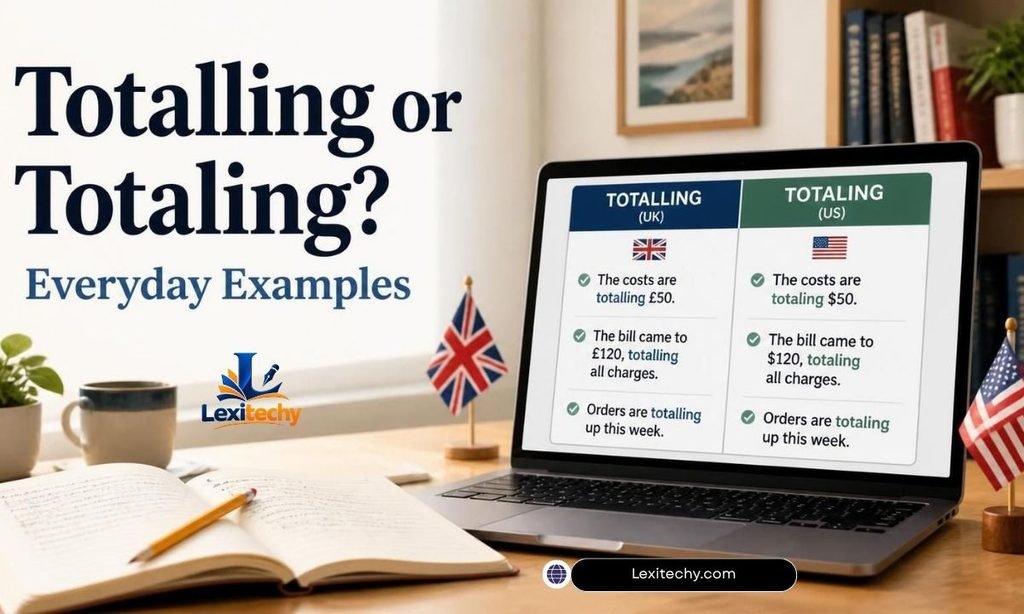
Everyday Examples
Seeing the word in context makes the rule easier to remember. The examples below use the American spelling, which is the right choice for a US audience.
Business
- The invoices are totaling $18,400 for the month.
- She totaled the expenses before the team meeting.
Personal Finance
- Your monthly bills are totaling more than your budget allows.
- He totaled his savings and found he was close to his goal.
Education
- The teacher is totaling the quiz scores now.
- The class project totaled 40 points out of 50.
Sports
- The team is totaling more yards per game than last season.
- Her points totaled 28 by the end of the third quarter.
Insurance
- The adjuster totaled the sedan after the accident.
- Claims totaling $2 million were filed after the storm.
British-Style Examples
British writers use the same sentences, with a double L:
- The accountant is totalling the figures for the quarter.
- Repairs totalled £3,200, so the garage wrote off the car.
- She totalled the marks and posted the results.
Dictionary-Style Word Details
Here is a short reference for the word “total,” written in a style similar to a dictionary entry.
Verb
Total (verb): to add numbers together, to amount to a certain figure, or to destroy a vehicle beyond repair. Forms: total, totals, totaling or totalling, totaled or totalled.
Noun
Total (noun): the whole amount, or the result of adding. Example: “The total was higher than expected.” It can also be an adjective meaning complete, as in “total silence.”
Synonyms
Depending on the meaning, you can use these alternatives:
- add up
- sum
- tally
- come to
- amount to
- wreck (for the vehicle meaning)
Totaling pronunciation
Totaling is pronounced TOH-tuh-ling, with three syllables. The stress falls on the first syllable. Totalling is pronounced the same way, so the spelling changes but the sound does not.
Example Sentences
- The treasurer is totaling the donations from the fundraiser.
- Costs totaling $900 were added to the bill.
- The old truck was totaled in the crash.
Word History
The word comes from the Latin totus, which means “whole.” It passed through Medieval Latin and French before entering English as an adjective and a noun. The verb use, meaning to add up, developed later from those older forms.
Phrases Containing
Common phrases with the word include:
- grand total
- sum total
- in total
- total up
- running total
- total loss
- totaling up
FAQs
How do you spell “totalling” in the UK?
In the UK, the standard spelling is totalling, with two Ls. The past tense is totalled, also with two Ls.
How to use totaling?
Use totaling as the -ing form of the verb, as in “The invoices are totaling $500.” It is the standard US spelling.
Does totaling have one L or two?
In American English, totaling has one L before the -ing ending. In British English, totalling has two Ls.
Is “totaling” a word?
Yes, totaling is a real word and the standard American spelling. It is listed in major US dictionaries.
Conclusion
The question of totalling or totaling is a question of region, not meaning. American English uses totaling and totaled, while British English uses totalling and totalled. Both spellings share the same meanings, from adding numbers to describing a wrecked car, and both are correct in their own setting. The base verb, the noun, and the form “totals” never change.
To choose with confidence, start with your audience. Use one L for US readers and two Ls for readers in the UK and most Commonwealth countries. Keep the same style from the first line to the last, and check other words such as color and colour for a matching pattern. With that one habit, you can avoid the most common mistakes and write clearly every time.

Emily Carter is an English content writer and SEO specialist with 5 years of experience in creating clear, helpful, and search-friendly content. She writes about grammar, word meanings, synonyms, vocabulary, and everyday English usage. Her goal is to make confusing words and language rules simple, practical, and easy to understand.


Pingback: Principal or Principle? Discover the Correct Word Fast
Pingback: Cosy or Cozy? Discover the Correct US English Spelling