
You type a sweet message, stare at the screen, and freeze. Is it goodnight or good night? One wrong space and you wonder if everyone will notice. Relax. The difference is small, the rule is simple, and by the end of this article you will pick the right one without a second thought. Even at midnight.
Quick Answer: Goodnight or Good Night?
Use good night (two words) when you say farewell or wish someone a restful evening. Use goodnight (one word) when it works as a noun or adjective, like “a goodnight kiss” or “say goodnight.”
Quick examples:
- “Good night, see you tomorrow!” (a greeting)
- “She gave the kids a goodnight hug.” (a describing word)
That is the core rule. The rest of this article shows you why it works and how to apply it fast.
Meaning and Definition of Each Word (Goodnight or Good Night)

Both forms carry the same warm idea: a wish for a peaceful night. What changes is the job each one does in a sentence.
1. Good Night (Two Words)
“Good night” is an expression you say when you part ways in the evening or before sleep. It works like “good morning” or “good afternoon.” Dictionaries label it an interjection, which is a fancy way of saying a short phrase you say out loud.
| Check Out These Articles |
| Received or Recieved? Discover the Correct Spelling |
| Benefitted or Benefited? Discover the Correct Spelling |
| Compliment or Complement? Easy Ways to Get It Right |
2. Goodnight (One Word)
“Goodnight” is the compact form. It usually works as a noun (“She said her goodnights”) or as an adjective (“a goodnight text”). It also appears as a casual one word farewell, especially in informal writing.
Think of it this way: the two word version is the formal handshake, and the one word version is the cozy hug.
Where the Phrase Comes From
The phrase has deep roots. Old English speakers combined gōd (good) and niht (night) to wish people well as darkness fell. Writers across the centuries kept using the phrase, and Shakespeare put it in the mouths of his characters many times.
For a long time, people wrote it as two separate words, and sometimes with a hyphen. Over time, English did what it always does. Common pairs started merging into single words, like “today” and “tonight.” That is why “goodnight” now exists beside “good night.”
Language evolves in small steps, and this one is still in motion. That is also why you see both forms everywhere.
Key Differences Between Goodnight or Good Night
Here is the side by side view, so you can scan it in ten seconds.
| Feature | Good Night | Goodnight |
| Number of words | Two | One |
| Main role | Greeting or farewell | Noun or adjective |
| Formality | Standard and formal | Casual and flexible |
| Example | “Good night, everyone.” | “A goodnight kiss.” |
| Safest for emails | Yes | Sometimes |
The takeaway: when you greet someone, choose two words. When you describe or name something, choose one.
Goodnight or Good Night When Going to Bed?

You are about to sleep and want to send the perfect sign off. Which one fits?
Shortcut rule: if you are speaking to someone, write “good night.”
- “Good night, Mom.”
- “Good night, and sleep well.”
If you are describing the moment, use “goodnight.”
- “He blew a goodnight kiss.”
- “The goodnight story took ten minutes.”
Notice something? The greeting stays two words because it works like a sentence by itself. The one word form needs company in a sentence to make sense.
Goodnight or Good Night in Text Messages
Texting loosens the rules, and nobody will report you to the grammar police. Many people type “goodnight” as a single word because it feels faster and friendlier. Both forms get understood instantly.
Still, a smart habit helps:
- Personal texts: either form works.
- Work emails and messages: use “good night” to keep things polished.
- Social media captions: pick whichever matches your tone.
Simple rule for texting: casual chat allows both, professional writing prefers two words.
Examples in Sentences
Seeing real sentences makes the rule click faster than any explanation. Here are both forms in action.
Using “Good Night”:
- “Good night, class. Finish your homework.”
- “I said good night to my neighbor and walked home.”
- “Wishing you a good night and sweet dreams.”
Using “Goodnight”:
- “The goodnight routine includes a story and a glass of water.”
- “She whispered a quick goodnight and turned off the light.”
- “Their goodnight call lasted two hours.”
Spot the pattern? In the first group, the words act as a wish or greeting. In the second group, they act as a thing or a descriptor.
Goodnight or Good Night in UK and US English
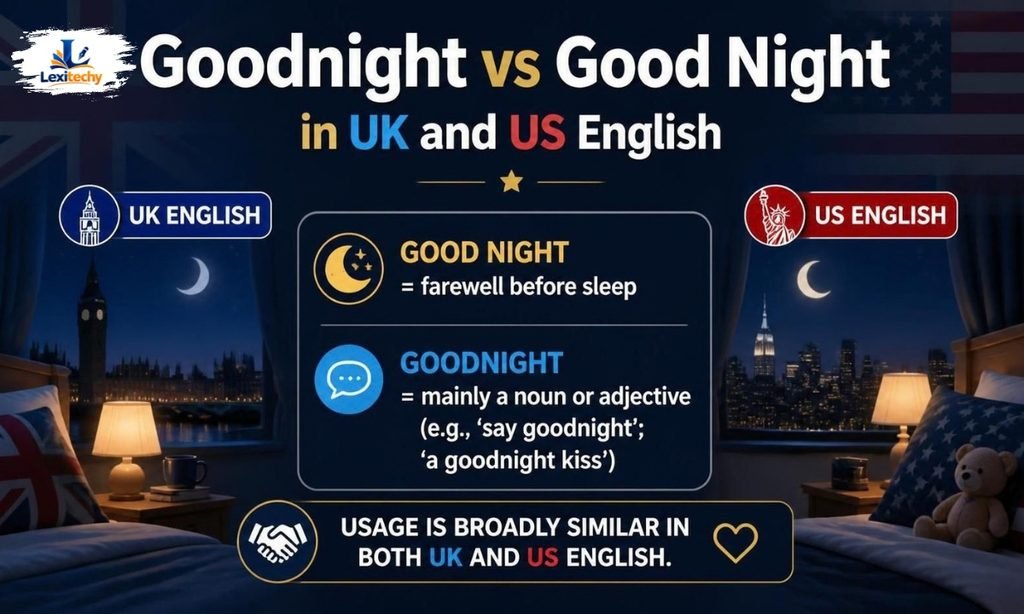
Does the Atlantic Ocean change anything here? A little. Most major dictionaries, including Oxford, treat “good night” as the standard form of the greeting. They list “goodnight” as an accepted variant, especially in informal or American usage.
Oxford based rule: when in doubt, choose two words for the farewell. You will match the traditional standard in both UK and US writing.
UK rule, easy way: British writers lean toward two words in formal text. They accept one word in relaxed contexts like personal notes.
American English tends to relax faster, so you will see “goodnight” more often in US media, captions, and song titles. Either way, the two word farewell never looks wrong.
Common Mistakes
Even confident writers trip on this one. Here are the four most frequent slips.
Mistake 1: Using “goodnight” as a formal farewell. A business email that ends with “Goodnight, team” feels slightly off. Use “Good night, team.”
Mistake 2: Using “good night” as an adjective. Writing “a good night kiss” is incorrect when you mean the kiss given at bedtime. Write “a goodnight kiss.”
Mistake 3: Overusing the one word form. Because it looks neat, people apply it everywhere. Keep it for noun and adjective jobs.
Mistake 4: Switching forms in the same piece. Pick one approach per document. A text with “good night” in line one and “goodnight” in line three looks careless.
One more thing worth knowing: “good night” can also describe an actual night that went well. “We had a good night at the concert” uses two separate words because “good” simply describes “night.” No greeting involved.
Easy Tricks to Remember the Difference

Memory tricks beat memorizing grammar rules. Try these four.
- Think of usage. Saying it to someone? Use two words. Describing something? Use one.
- Replace trick. Swap in “good morning.” If the sentence still works, write two words. If it sounds strange, you probably need “goodnight.”
- Space rule. A greeting has room to breathe, so it gets a space.
- Remember common phrases. “Good night, sleep tight” has two words. “Goodnight kiss” has one.
Pick the trick that sticks and ignore the others. You do not need all four.
Which One Should You Use?
Here is the practical answer for everyday life.
Use “good night” when:
- You say farewell in the evening.
- You write formal or professional messages.
- You mean a night that was good.
Use “goodnight” when:
- You use it as a noun (“She said her goodnights”).
- You use it as an adjective (“goodnight story”).
- You write a casual text or caption where either form is fine.
Related words you can use instead:
- For “good night”: sleep well, sweet dreams, rest well, nighty night
- For “goodnight”: bedtime, farewell, sign off, parting wish
Variety keeps your writing fresh, and your friends will stop thinking you send the same message every evening.
FAQs About Goodnight or Good Night
What is correct, goodnight or good night?
Both are correct, but they do different jobs. “Good night” is the standard greeting. “Goodnight” works best as a noun or adjective, and appears often in casual writing.
Is “goodnight” grammatically correct?
Yes. Many dictionaries accept it, particularly as a noun or adjective. For formal farewells, “good night” remains the safer choice.
Is good night different from goodnight?
Yes, mainly in function. Two words give a greeting, one word names or describes something. The meaning behind both stays the same.
Is it right to say “good night”?
Absolutely. It is the traditional, widely accepted farewell, and it fits every situation from texts to formal letters.
Conclusion (Goodnight or Good Night)
So, goodnight or good night? Say it with a space when you wish someone well. Join it together when it names or describes something. If you ever feel unsure, “good night” never fails you.
Now you know the rules, the history, and the common traps. Go send that message with confidence, and sleep well.

Emily Carter is an English content writer and SEO specialist with 5 years of experience in creating clear, helpful, and search-friendly content. She writes about grammar, word meanings, synonyms, vocabulary, and everyday English usage. Her goal is to make confusing words and language rules simple, practical, and easy to understand.


Pingback: Followup or Follow Up? Discover the Correct Usage