

You type a sentence, pause, and stare at the screen. Is it gage or gauge? Both look right, and both seem to be in the dictionary. One wrong pick makes your writing look sloppy, especially in reports, emails, or product listings. Relax. This guide settles the gage or gauge question in about two minutes, with zero grammar headaches.
Quick Answer
Gauge is the standard spelling in American English for almost everything. It means to measure something, to estimate something, or the tool that does the measuring. Gage is a rare variant. It appears in some technical fields like engineering, and it has an old meaning of a pledge or a challenge.
If you are unsure, write gauge. You will be right about 95 percent of the time.
That covers the short version. Now let’s see why two spellings exist at all.
Gage or Gauge Synonym
Before we split hairs, it helps to know that these two words overlap in meaning in some settings. In technical writing, “gage” and “gauge” both name a measuring device. That is why the confusion exists.
Here are quick substitutes you can use in place of “gauge” when you want to avoid the issue completely:
- measure
- assess
- estimate
- judge
- meter or indicator (for tools)
Swapping in one of these works in a pinch. But you will meet both spellings in the wild, so let’s define them properly.
Meaning and Definition of Each Word (Gage or Gauge)
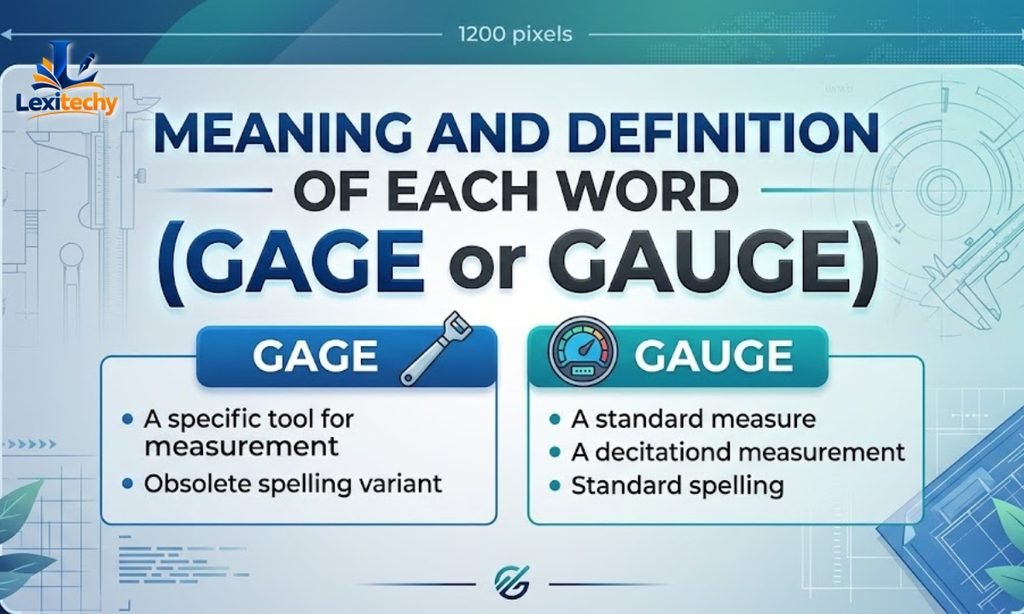
Each word has its own job, and one of them has a much busier schedule.
1. Gauge
Gauge works as both a verb and a noun.
As a verb, it means to measure or to estimate. You gauge a crowd’s mood, a recipe’s saltiness, or how much time you have left before your boss walks in.
As a noun, it means an instrument that measures something, like a fuel gauge, a tire pressure gauge, or a rain gauge. It also means a standard size or thickness, like wire gauge or the gauge of a railroad track. Standard railroad gauge, for the record, is 4 feet 8.5 inches.
| More Articles to Explore |
| At Least or Atleast? Discover the Correct Spelling |
| Seamless vs. Seemless: Discover the Correct Spelling |
| Verbage or Verbiage? Discover the Correct Word |
2. Gage
Gage has two lives.
First, it is a technical variant of “gauge,” common in engineering, manufacturing, and quality control. Think “gage block” or “strain gage.”
Second, it is an older word meaning a pledge, a security, or a challenge. Medieval knights threw down a gage (usually a glove) to challenge someone to a duel. It also names a fruit, the greengage plum, and it shows up as a last name and a first name.
Now that each word has its own identity, let’s compare them side by side.
Key Differences Between the Words
The difference comes down to frequency, field, and meaning.
- Frequency: Gauge appears far more often in everyday writing.
- Field: Gage lives mostly in engineering and metrology (the science of measurement).
- Meaning: Gage can also mean a pledge or a challenge. Gauge never does.
- Verb use: For the verb “to measure or estimate,” use gauge. Gage as a verb sounds dated.
So the two words share a measuring job in technical writing, but only one is safe for general use. Let’s see how that plays out across English.
Gage or Gauge in English
Both words trace back to the same French roots. Old French had “gage,” meaning a pledge, and the Old North French form “gauge” referred to a measuring rod and standard measure. Over centuries, the “gauge” spelling won out in general English because it matched the measuring sense most people needed.
American English, British English, and most style guides prefer gauge. Some technical standards bodies still print “gage” in their documents. For example, American engineering texts often use “gage pressure” and “strain gage.” That is a house style choice, not a spelling mistake.
Why does this matter? Because once you know where each word comes from, the meanings stop feeling random.
Gage or Gauge Meaning
Let’s pin down the meaning with a simple rule.
If you are measuring, judging, or estimating, you want gauge. If you are talking about a pledge, challenge, or a specific engineering term, gage may fit.
Here is how that looks in everyday terms:
- You gauge how the audience feels about your joke.
- A knight lays down a gage and waits for a reply.
- A machinist checks a part with a gage block.
Notice that only the second sentence feels truly old fashioned, and only the third is clearly technical. The first one is ordinary life. That brings us to one of the most searched phrases around these words.
Gage or Gauge Interest

Gauge interest is the correct phrase. It means to find out how much interest people have in something.
For example, a marketing team might send a survey to gauge interest in a new product before launch. A teacher might ask a quick question to gauge interest in a field trip.
“Gage interest” appears occasionally, but most editors flag it as an error. Since you are measuring something intangible, gauge is the safe choice every time.
Measuring interest is abstract. Measuring pressure is concrete, so let’s look at that next.
Gage or Gauge Pressure
You will see both gauge pressure and gage pressure in print.
Gauge pressure is the pressure measured relative to the air around you. A tire inflated to 32 psi (pounds per square inch) reads 32 psi on a gauge. That does not count the atmospheric pressure of roughly 14.7 psi at sea level.
The spelling “gage pressure” shows up in some physics and engineering textbooks, but “gauge pressure” is far more common and fully correct. For general readers, writers, and students, use gauge pressure.
Let’s make all this stick with a few real life samples.
Gage or Gauge Example
Here are quick examples that show the difference in action.
- The mechanic checked the tire gauge and added air.
- Our manager wanted to gauge how the team felt about the new schedule.
- The engineer logged data from the strain gage on the bridge cable.
- The knight threw down his gage and demanded a duel.
Four sentences, four clear uses. Now let’s put the main points in a table so you can scan them fast.
Comparison Table
| Feature | Gauge | Gage |
| Common in everyday English | Yes | No |
| Verb meaning (to measure or estimate) | Yes | Rare |
| Noun meaning (measuring tool) | Yes | Yes, in technical fields |
| Pledge or challenge | No | Yes, old usage |
| Safe for general writing | Yes | Only in specific cases |
| Example | fuel gauge | gage block |
If you only remember one row, remember the second to last. It is your safety net. Let’s see these words inside full sentences.
Examples in Sentences
Using “Gauge”
- She tried to gauge his reaction by watching his eyebrows.
- The fuel gauge dropped to empty right as we passed the last gas station.
- Scientists use a rain gauge to measure rainfall.
- Teachers often gauge understanding with a quick quiz.
- The thick gauge wire handled the heavy electrical load.
Using “Gage”
- The inspector used a gage to verify the part’s diameter.
- In the old tale, the knight left his gage on the table.
- We bought a bag of greengage plums at the market.
- Phineas Gage is a famous name in the history of neuroscience.
- The lab technician calibrated the strain gage before testing.
Seeing the words in context helps, but mistakes still sneak in. Here are the biggest ones.
Common Mistakes
Most errors come from guessing the spelling by sound. Both words sound identical, so your ear cannot help you.
Incorrect:
I need to gage the mood of the room.
Correct:
I need to gauge the mood of the room.
Incorrect:
The gage on my dashboard stopped working.
Correct:
The gauge on my dashboard stopped working.
Incorrect:
We sent a poll to gage customer interest.
Correct:
We sent a poll to gauge customer interest.
Notice the pattern. Every fix lands on gauge. That is no accident. Next, a topic that confuses builders, crafters, and gun owners alike.
Gage or Gauge for Metal Thickness

For metal thickness, use gauge. Sheet metal comes in gauge sizes, and the numbers run backward: a lower number means thicker metal.
For example, 10 gauge steel is thicker than 20 gauge steel. Standard 12 gauge steel sheet measures about 0.105 inches, or roughly 2.7 millimeters. Keep in mind that gauge charts differ by material. Steel, aluminum, and stainless steel all use slightly different measurements for the same gauge number.
Shotguns use gauge too, but the system works differently. A 12 gauge shotgun gets its name from the number of lead balls, each fitting the bore, that weigh one pound. That is why a smaller number means a bigger bore there as well.
Still unsure which spelling to pick? A memory trick can help.
Tips to Remember the Difference
Here are simple ways to lock it in:
- Gauge has a “u” for “use it.” It is the one you will use most.
- Gauge and measure both contain the letter “u” and “a” in a similar pattern. If you are measuring, pick gauge.
- Gage is for gages in a gaggle of engineers. If you are not writing technical content, skip it.
- When in doubt, choose gauge. It is accepted almost everywhere.
A tricks list is nice, but a clear decision guide is better. Here it is.
When to Use Each Word
Think of this as your “Which one should you use?” cheat sheet.
Use “Gauge” When:
- You are writing for a general audience.
- You mean to measure, estimate, or judge.
- You are naming a tool like a fuel gauge or tire gauge.
- You describe wire, sheet metal, or railroad size.
- You are writing marketing, school, or business content.
Use “Gage” When:
- You are following a technical standard that uses it.
- You mean a pledge, security, or a challenge in a historical setting.
- You are naming the greengage plum.
- You are writing a person’s name, like Phineas Gage.
One technical phrase deserves its own spotlight, so let’s look at it.
Strain Gage or Gauge
Both spellings of strain gage or gauge are correct. A strain gauge is a sensor that measures how much an object stretches or compresses. Engineers attach one to a bridge, a beam, or a machine part, and it reports tiny changes through electrical resistance.
Technical journals and standards often print “strain gage.” General science sites and news articles lean toward “strain gauge.” Pick one and stay consistent throughout your document. If your audience is not made up of engineers, strain gauge is the safer choice.
Now let’s check whether any grammar rules apply here.
Grammar Rules (If Applicable)
Grammar rules for these words stay simple.
- Verb forms of gauge: gauge, gauges, gauged, gauging. Drop the final “e” before “ing,” so it is “gauging,” not “gaugeing.”
- Noun plural: gauges.
- Verb forms of gage: gage, gages, gaged, gaging (rare).
- Consistency rule: If you pick gage in a technical document, use it every time.
Grammar settled. If you want to vary your wording, here are some alternatives.
Synonyms or Related Words
For “Gauge”:
- measure
- assess
- estimate
- evaluate
- meter
- indicator
- standard
For “Gage”:
- pledge
- security
- challenge
- deposit
- measuring tool (in technical use)
Using a synonym now and then keeps your writing fresh. Before we close, let’s answer the questions people ask most.
Frequently Asked Questions
Is gage the same as gauge?
Not always. In technical fields, “gage” can be a variant spelling of “gauge.” In general English, though, gage means a pledge or challenge, and gauge is the standard word for measuring.
Do you gage or gauge interest?
You gauge interest. This is the standard and accepted form in American English.
What does it mean to gage something?
To “gage” something usually means to measure it in a technical setting. Outside engineering, most writers use “gauge” for this meaning.
Is it 12 gage or 12 gauge?
It is 12 gauge. This applies to shotguns, wire, and sheet metal.
Conclusion
So, gage or gauge? Pick gauge for everyday writing, measuring, estimating, and naming tools. Save gage for technical standards, historical settings, and proper names.
Next time a sentence makes you hesitate, remember the simple rule: if you are measuring anything, the “u” belongs. Your writing will look sharp, and your inner editor can finally take a coffee break.

Emily Carter is an English content writer and SEO specialist with 5 years of experience in creating clear, helpful, and search-friendly content. She writes about grammar, word meanings, synonyms, vocabulary, and everyday English usage. Her goal is to make confusing words and language rules simple, practical, and easy to understand.


Pingback: Weiner or Wiener? Discover the Correct Spelling Now
Pingback: High School or Highschool? Discover the Correct Spelling
Pingback: Woah or Whoa? Discover the Correct Spelling Fast
Pingback: Principal or Principle? Discover the Correct Word Fast