
You are typing a message about a weekend hike, and you stop mid-sentence. Was it a long trek through the woods, or a long treck? Many writers pause at this exact spot, and a wrong guess can make an otherwise clean sentence look careless, especially in an email, a school paper, or a travel post.
This guide settles the Treck or Trek question in plain terms. You will learn which spelling is correct, what the word means, how to form its past tense, and why the mistake happens so often. Short examples throughout show how the word works in real sentences, so you can pick the right spelling quickly and move on with your writing.
Quick Answer
The correct spelling is trek. The spelling “treck” is not a standard English word, and dictionaries do not list it as an accepted variant. If you mean a long, difficult journey, or the act of making one, write “trek.”
Here is the short version:
- Correct: “We began the trek at sunrise.”
- Incorrect: “We began the treck at sunrise.”
- Correct: “They trekked across the desert.”
- Incorrect: “They trecked across the desert.”
The same rule applies to related forms. The correct spellings are trek, treks, trekked, trekking, and trekker.
Why People Confuse Them
Most spelling mistakes happen because English spelling does not always match sound. The word “trek” ends in a hard “k” sound, and English has many words that end that sound with “ck,” such as “check,” “deck,” “neck,” and “wreck.” Because “trek” rhymes with all of them, writers often add the extra “c” without thinking.
Another reason is the way the word is learned. Many people hear “trek” in conversation or in movie titles long before they see it written in a dictionary. When you only hear a word, your brain fills in the spelling that feels most familiar, and “ck” feels very familiar. That is why why do people spell trek as treck is such a common question.
Is Treck a Word
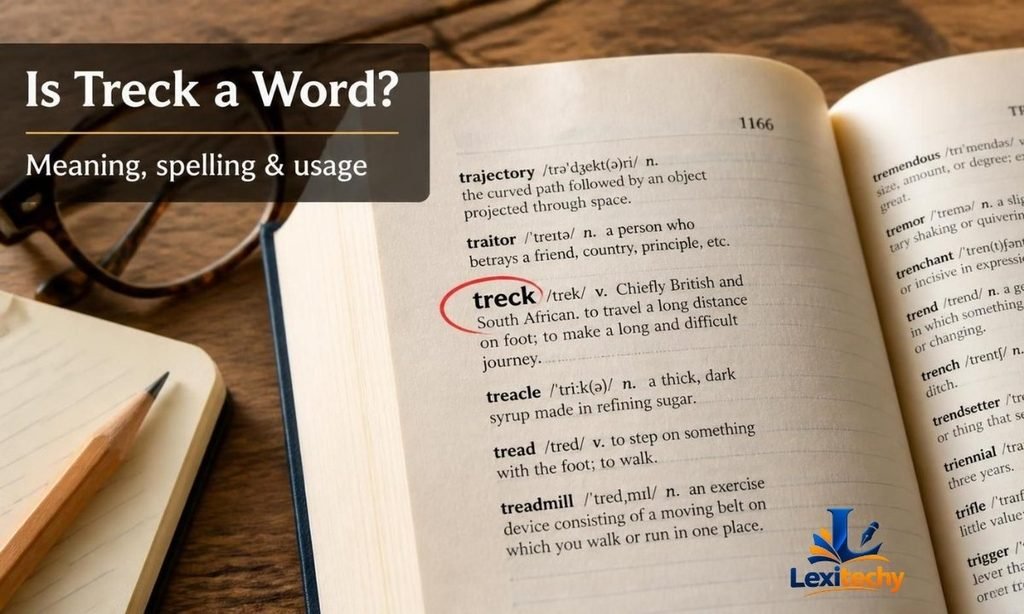
For everyday writing, is treck a real word has a simple answer: no. It is not an accepted spelling of “trek” in standard American or British English. Spell checkers will usually flag it, and editors will correct it.
You may still see “Treck” used as a surname, a business name, or a brand name. In those cases, the owner has chosen that spelling on purpose, and it works like any other proper name. It does not change the spelling of the common word. If you are writing about a journey, the word you want is “trek.”
Key Differences at a Glance
A quick comparison makes the difference between treck and trek easy to remember. One is a real English word, and the other is a spelling error. The table below shows the key points.
| Feature | Trek | Treck |
| Correct spelling | Yes | No |
| Part of speech | Noun and verb | None |
| Listed in dictionaries | Yes | No |
| Past tense | Trekked | Not applicable |
| Present participle | Trekking | Not applicable |
| Pronunciation | /trɛk/ | Not applicable |
If you remember only one thing, remember this: there is no “c” in trek. The word is four letters long, and every letter is needed.
Meaning and Usage Difference
Since “treck” has no standard meaning, the real question is what trek means. As a verb, it means to travel on foot over a long or hard route, often across rough ground. As a noun, it means the journey itself, especially one that takes effort and time.
People also use “trek” more loosely. A long walk across a large parking lot, or a tiring trip across town, can be called a trek, usually with a bit of humor. The word always suggests distance and effort, so it fits less well with short, easy trips.
Tone, Context, and Formality
“Trek” works in both formal and casual writing. In a news story, a travel guide, or a school essay, you can write about an expedition or a mountain trek without any problem. In casual speech, you might say, “It’s a bit of a trek to the airport,” and the tone stays friendly and relaxed.
Because “treck” is a misspelling, it fits no tone or context at all. It can weaken a formal document, a résumé, or a published article. When in doubt, use the standard spelling in every setting.
Which One Should You Use?
Use “trek” every time you need this word. There is no situation in standard writing where “treck” is the better choice. The only exception is a proper name that already uses that spelling, such as a person’s surname.
A simple memory trick can help. Think of “trek” as a short word for a long journey, and keep the spelling short too. If you also know the word “track,” remember that “trek” has no “a” and no “c.” Three letters surround the “e,” and none of them is a “c.”
Trek or Treck Halloween

Around October, some readers wonder about trek or treck Halloween phrases. The familiar tradition is “trick or treat,” and neither “trek” nor “treck” belongs in that phrase. Writing “trek or treat” is a mix-up caused by similar sounds.
“Trek” can still show up in Halloween writing for a different reason. Many people wear costumes based on the Star Trek series, and the word “Trek” is part of that title. A sentence such as “She wore a Star Trek uniform to the party” is correct, while “Star Treck” is not.
When One Choice Sounds Wrong
Sometimes a writer sees both spellings and feels that “treck” looks right because it resembles other words. This is a normal reaction, and it explains why the error is common. Looks alone are not a reliable guide in English.
A better method is to check the word against its family. If you write “trekking” or “trekked,” you would not add a “c” in those forms either. Seeing “trecking” or “trecked” on the page often feels odd, and that odd feeling is a useful signal that the base spelling is also wrong.
Common Mistakes (and Quick Fixes)
Most errors with this word follow a few predictable patterns. Here are the most common ones, with quick fixes:
- Treck instead of trek: Remove the extra “c.” Write “a long trek.”
- Trecking instead of trekking: The correct spelling of trekking or trecking is “trekking,” with a double “k” and no “c.”
- Trecked instead of trekked: The correct spelling of trekked or trecked is “trekked.”
- Treak instead of trek: This is another misspelling. The word has no “a.”
- Trekk instead of trek: The base word ends in a single “k.”
The double “k” in “trekked” and “trekking” follows a standard spelling rule. When a one-syllable word ends in a single vowel followed by a single consonant, the consonant is doubled before “-ed” or “-ing.” The same rule applies to “stop” and “stopped” or “plan” and “planning.”
Everyday Examples
Seeing the word in context helps the correct spelling stick. These examples show how to use trek in a sentence in different ways:
- “The family planned a three-day trek through the national park.”
- “We trekked up the hill to get a better view.”
- “It was a long trek from the parking lot to the stadium.”
- “They are trekking across the region next summer.”
- “She is an experienced trekker who prefers mountain trails.”
Notice that each sentence uses a standard form of the word. The same spellings apply whether you are writing a text message, a school report, or a travel blog.
Dictionary-Style Word Details
Here is a compact reference for the word, written in the style of a dictionary entry. Pronunciation: /trɛk/, which rhymes with “neck” and “deck.” The word has one syllable.
Verb
As a verb, “trek” means to make a long, slow, or difficult journey, usually on foot. Its forms are trek, treks, trekked, and trekking. The correct past tense of trek is “trekked,” not “trecked.”
Example: “They trekked for hours before reaching the village.”
Noun
As a noun, “trek” means a long and often hard journey. It can also mean a tiring trip of any length. The plural is “treks.”
Example: “The trek to the summit took two days.”
Synonyms
Some synonyms for trek include:
- hike
- journey
- expedition
- march
- tramp
- slog
- trudge
These words are close, but not identical. “Hike” is usually a pleasant walk, while “slog” and “trudge” stress effort and tiredness. “Trek” sits between them, suggesting a long route with some difficulty.
Example Sentences
- “Many visitors take a guided trek along the river.”
- “He trekked through the snow to reach help.”
- “After a long trek, the group stopped for lunch.”
- “Trekking poles can make steep paths easier.”
Word History
“Trek” came into English from Afrikaans, which borrowed it from Dutch. The Dutch verb “trekken” means to pull, draw, or travel. English speakers began using the word in the 1800s, mainly in connection with ox-wagon journeys in southern Africa.
The term became widely known through the Great Trek, a migration of Dutch-speaking settlers in the 1830s and 1840s. Over time, the word grew beyond that setting and now covers any long, difficult journey. The spelling stayed “trek” because it comes directly from the Dutch root “trekken,” which has no “c” before the “k.”
Treck or Trek Slang

Slang uses of “trek” are mild and easy to follow. In casual speech, people use “trek” for any tiring trip, such as “It’s a real trek to the third floor.” The word also appears in fan culture, where fans of Star Trek are sometimes called “Trekkers” or “Trekkies.”
There is no established slang meaning for “treck.” If you see it in a text or on social media, it is most likely a typing error or a deliberate stylized spelling. For clear communication, stick with “trek.”
Phrases Containing Trek
The word appears in several common phrases and names. Knowing them can help you spot the right spelling in context:
- Star Trek: the well-known science fiction franchise
- The Great Trek: the historical migration in southern Africa
- Trek through: to travel with effort across a place, as in “trek through the jungle”
- A trek to: a long trip toward a destination
- Trekking pole: a walking stick used on trails
- Trek bike: a bicycle from a company named Trek
Each of these uses the same four-letter spelling. If you ever see one written with “treck,” it is an error unless it is a name that was chosen on purpose.
FAQs
How do you spell trek or treck?
The correct spelling is “trek.” The form “treck” is a common misspelling and is not accepted in standard American or British English.
What does “treck” mean?
“Treck” has no standard meaning in English. It is usually a misspelling of “trek,” which means a long, difficult journey or the act of making one.
What is a treck?
A “treck” is not a recognized English word. If you mean a long journey, especially on foot, the correct word is “trek.”
What is the meaning of treak?
“Treak” is not a standard English word either. It is most likely a typing mistake for “trek,” meaning a long and difficult journey.
Is it trekked or trecked?
The correct past tense is “trekked,” with a double “k.” The form “trecked” is a misspelling.
Does spelling differ in American and British English?
No. Treck or trek in American and British English has the same answer: “trek” is correct in both, along with “trekked” and “trekking.”
Final Thoughts
The Treck or Trek question has a clear answer. “Trek” is the only correct spelling for the word meaning a long, difficult journey, and “treck” is a common mistake. The same goes for related forms: write “trekked,” “trekking,” and “trekker,” never “trecked,” “trecking,” or “trecker.”
Keep the main points in mind. The word came from Dutch and Afrikaans, it works as both a noun and a verb, and it carries a sense of distance and effort. When you are unsure, remember that “trek” has four letters and no extra “c.” With that simple check, you can write the word correctly in emails, essays, and travel stories alike.

Emily Carter is an English content writer and SEO specialist with 5 years of experience in creating clear, helpful, and search-friendly content. She writes about grammar, word meanings, synonyms, vocabulary, and everyday English usage. Her goal is to make confusing words and language rules simple, practical, and easy to understand.