
You are typing an email, and your fingers freeze. Verbage or verbiage? Both look believable, and your spell checker stays suspiciously quiet. Pick the wrong one and a sharp eyed reader may smirk. Relax. Verbiage is the standard spelling, and this guide will help you never doubt it again.
Quick Answer
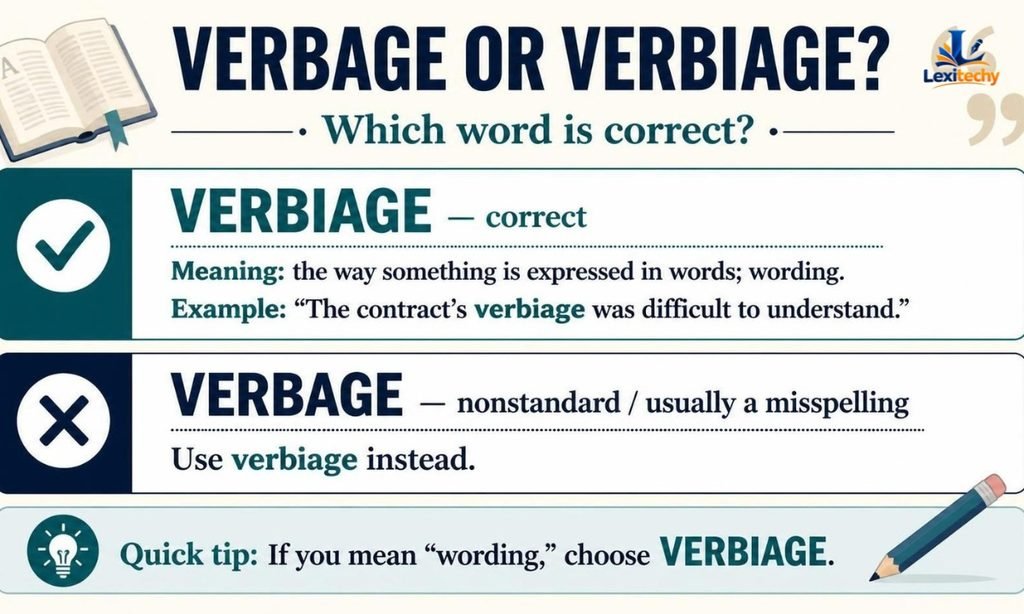
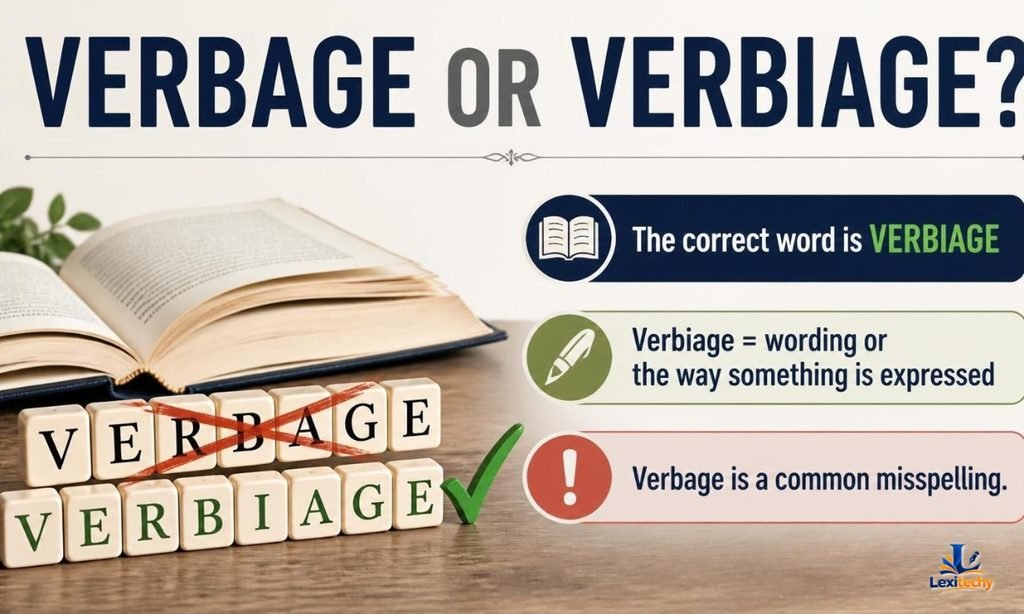
Verbiage is the correct spelling. It is a noun that means wording, especially wording that is wordy or overly complicated. Verbage is a common misspelling that dictionaries treat as nonstandard. Use “verbiage” in school, at work, and in anything you publish. Three syllables, one extra “i,” zero embarrassment.
Verbage or verbiage meaning
Both spellings point at the same idea: the words someone uses. The only difference is that one is accepted and the other is a slip. When people write “verbage,” they mean “verbiage.” They simply drop a letter on the way.
Verbiage carries two meanings. First, it can mean too many words, the kind of padding that hides a simple point. Second, it can mean the way something is worded, such as the exact phrasing of a contract or a sign. The sentence around the word tells you which meaning is at work.
Meaning and Definition of Each Word (Verbage or Verbiage)
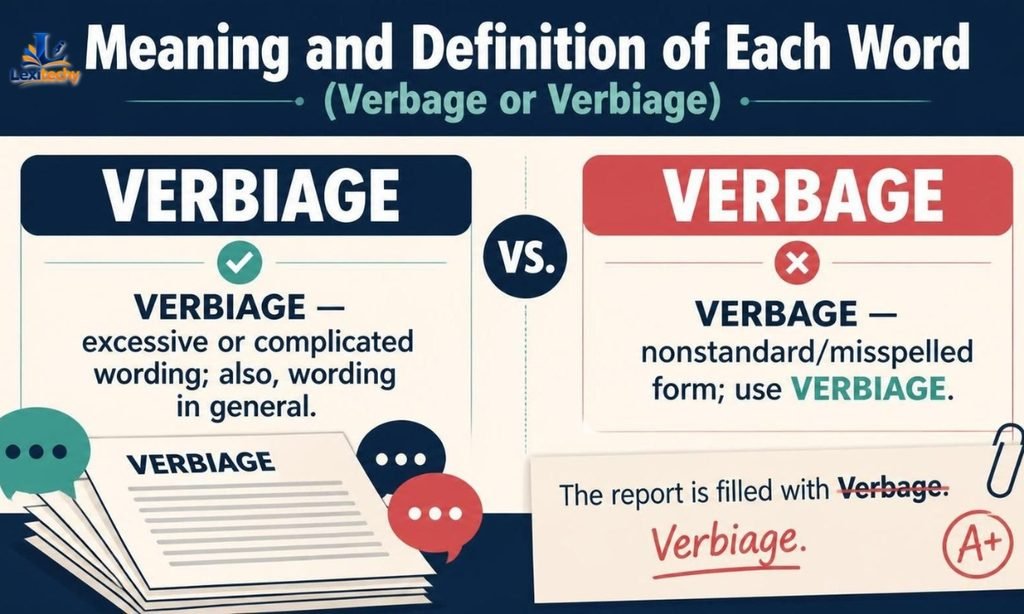
Let us look at both words one at a time, so nothing stays blurry.
1. Verbiage
Verbiage is a noun with two common senses:
- Excessive or needlessly complicated wording
- The specific choice and style of words in a text, speech, or document
Picture a ten page policy that could fit on an index card. That is the first sense. Now picture a manager asking, “Can you check the verbiage on this sign?” That is the second sense, and it is neutral. Some careful writers still reserve verbiage for the critical sense, so know your audience.
2. Verbage
Verbage is not a standard English word. It shows up in speech, texts, and rushed writing. A few dictionaries list it as a variant, and they usually attach a warning label. Think of it as verbiage with a missing middle. Editors will fix it, and style guides advise against it.
Verbage or verbiage in english
Why does this confusion exist at all? English has a famous gap between how words sound and how they look. Many speakers say verbiage so quickly that the middle sound blurs, and “verbage” is what the ear catches.
History adds a twist. Verbiage came into English from French in the 1700s. The French word traces back to a verb meaning to chatter. So the original idea was babble, which explains why the word still carries a slightly critical flavor.
You may see claims that the word has biblical roots. It does not. Its story is purely French and English, so treat any scriptural origin claim with suspicion.
Over time the word relaxed. Today people use it neutrally to mean wording or phrasing, especially in business and legal settings.
Key Differences Between the Words
The differences are small on the page and big in the eyes of an editor. Here is the short list:
- Spelling: verbiage includes “bi” in the middle, while verbage skips it.
- Status: verbiage is standard, while verbage is nonstandard.
- Syllables: verbiage has three, while verbage has two.
- Acceptance: verbiage passes editors, style guides, and spell checkers. Verbage often gets flagged.
- Usage in print: published books, news, and legal writing use verbiage overwhelmingly.
Notice the pattern. Every difference favors one word. This is not a close race.
Comparison Table
Here is the whole story in one glance:
| Feature | Verbiage | Verbage |
| Spelling status | Correct | Nonstandard |
| Syllables | 3 | 2 |
| Pronunciation | VUR bee ij | VUR bij |
| Dictionary listing | Standard headword | Rare variant at best |
| Safe for formal writing | Yes | No |
| Part of speech | Noun | Misspelling of the noun |
Save this table somewhere handy. It settles office debates in about four seconds.
Verbage or verbiage pronunciation
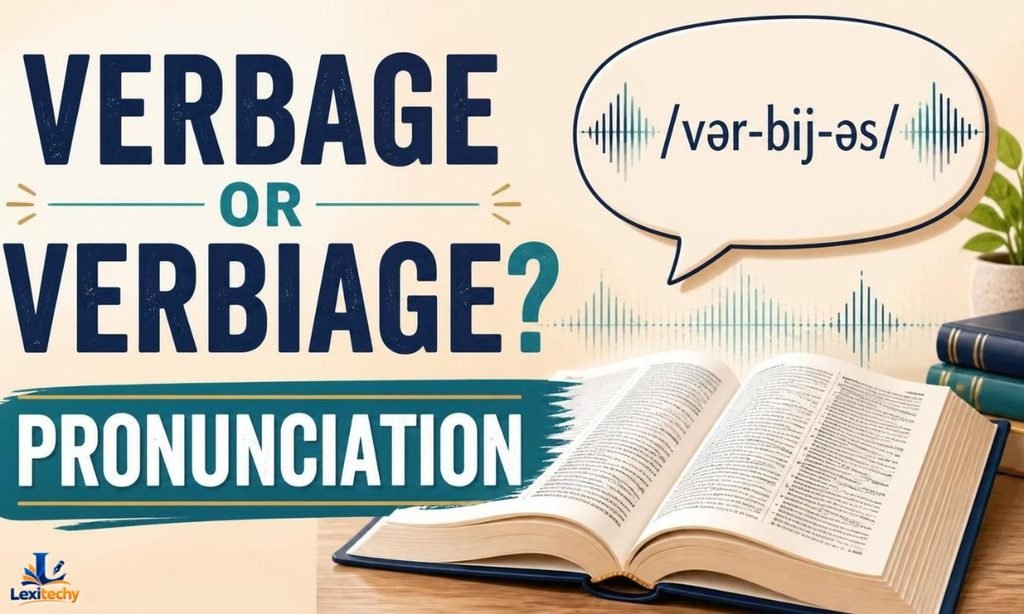
Say it out loud: VUR bee ij. The stress lands on the first syllable, and the word ends with “ij,” like the end of “bridge.” You should hear three beats.
Now say the misspelled version: VUR bij. Two beats. The mouth skips the “ee” sound, and that is exactly how the wrong spelling is born.
Here is the sneaky part. The word sounds like “garbage” and “cabbage,” which both end in a quick “ij” sound. Your brain pattern matches and shortens the word. Slow down once, count three beats, and the spelling follows.
| Don’t Miss These Posts |
| Received or Recieved? Discover the Correct Spelling |
| 28 Professional Ways to Say “I’m Not Feeling Well” |
| Compliment or Complement? Easy Ways to Get It Right |
Verbiage vs language
These two words live in the same neighborhood, but they are not roommates.
Language is a whole system of communication. English, Urdu, and Spanish are languages. The word also covers general wording, as in “the language of the law.”
Verbiage is narrower. It points to the actual words in one piece of writing or speech, and it often hints that there are too many of them.
A quick test: “English is a language” works. “English is a verbiage” does not. And “this contract’s verbiage is a maze” works better than “this contract’s language is a maze” if you want the sting of excess.
Examples in Sentences
Seeing the word in action is the fastest teacher. Let us start with the right way, then look at the slips.
Correct Usage of “Verbiage”
- The lawyer removed half the verbiage, and the contract finally made sense.
- Please review the verbiage on the warning label before it goes to print.
- Her speech was short, clear, and free of fancy verbiage.
- The app’s terms of service were buried under pages of verbiage.
- We rewrote the verbiage in the job post to sound friendlier.
Incorrect Usage of “Verbage”
- Wrong: The verbage in this email is confusing. Right: The verbiage in this email is confusing.
- Wrong: Cut the extra verbage from your essay. Right: Cut the extra verbiage from your essay.
- Wrong: Who approved this verbage? Right: Who approved this verbiage?
Same sentences, one letter pair apart. That tiny “bi” is doing a lot of work.
Common Mistakes
Most errors with this word fall into three buckets. Knowing them makes them easy to dodge.
1. Spelling Mistake
The classic error is writing “verbage” by following the sound of the word. Speed is the usual culprit. You type fast, the middle syllable slips away, and the spell checker may or may not catch it. Always reread this one on important documents.
2. Thinking Both Words Are Correct
Because you will see “verbage” in comments, texts, and even some company memos, it feels normal. Frequency is not correctness. A mistake repeated by many people is still a mistake, and editors do not grade on a curve.
3. Overusing “Verbiage”
Here is the irony. Writers who love this word often stuff it into every paragraph, and the result is exactly what the word describes. If you use verbiage five times on one page, you have created verbiage.
Use it where it fits, then switch to plainer words like wording, phrasing, or text.
Verbage or verbiage examples
Now let us move from single sentences to real situations where this word appears. Notice how it fits each setting.
- Contracts: A client asks, “Can we simplify the verbiage in section four?” They want clearer wording.
- Product labels: A designer flags that the verbiage on the package is too long for the front panel.
- Customer emails: A support lead trims the verbiage in a refund reply from six paragraphs to two.
- Websites: A marketer reviews landing page verbiage to match the brand voice.
- Job posts: A recruiter removes legal verbiage that scares off good candidates.
Each example follows a pattern. Someone is judging, trimming, or approving words. That is the word’s natural habitat.
Here is a quick before and after:
- Before: “The verbiage of the aforementioned clause shall be construed in a manner consistent with the foregoing.”
- After: “This clause means what the earlier clauses mean.”
Same idea, about one third of the words.
Tips to Remember the Difference
A few small tricks can lock the spelling in for good. Pick the one that sticks with you.
1. Think of “i” in Verbiage
The word has an “i” hiding in the middle, just before “age.” Imagine the “i” as a tiny person standing among the letters. If the person is missing, the word is wrong.
2. Remember: “Verbage” is Garbage
This one is silly, which is why it works. Both “verbage” and “garbage” end in “bage” or “bage” sounds, and the misspelling belongs in the same bin as garbage. Toss the wrong spelling out.
3. Use Spell Check
Turn on your spell checker and, for important documents, run a final search for “verbage.” It takes five seconds and protects your credibility.
4. Associate with “Verbose”
Verbiage and verbose share a root idea of wordiness. Verbose has a “bo” in the middle. Verbiage has a “bi.” If you can spell verbose, you can spell verbiage by changing one vowel and adding the ending.
Verbage or verbiage grammar
Grammar is where this word stays calm and well behaved. It does not change form, and it plays well with certain partners.
Common adjectives that go before it:
- Legal verbiage
- Technical verbiage
- Marketing verbiage
- Unnecessary verbiage
- Flowery verbiage
Common verbs that go with it: cut, trim, review, simplify, rewrite, and remove. Notice how many of them involve making less of it. That tells you something about the word’s reputation.
You will also see it with prepositions like “in” and “on,” as in “the verbiage in the report” or “the verbiage on the sign.”
When to Use Each Word (verbage or verbiage)
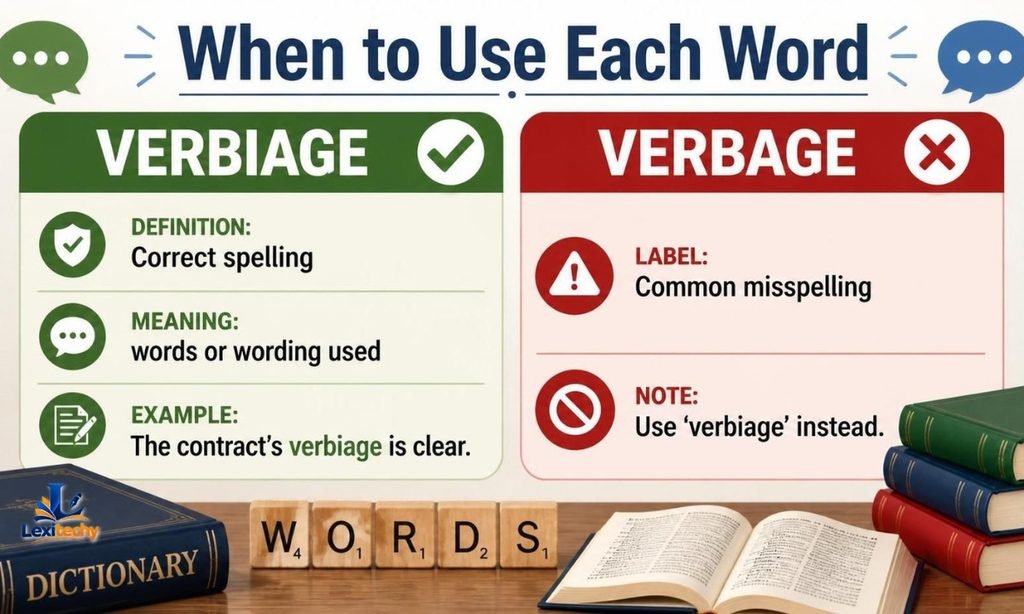
This is the section you can bookmark. It answers the question every reader secretly has: which one should you use?
When to Use “Verbiage”
Use it every time you mean wording or wordiness. That covers emails, essays, reports, resumes, websites, books, and social posts. If you are unsure, use verbiage. You will be right.
When to Use “Verbage”
Almost never. The only fair cases are quoting someone who wrote it, discussing the misspelling itself (as this article does), or writing dialogue where a character is meant to make the slip. Everywhere else, it is a typo wearing a trench coat.
Verbiage in a sentence
Want to build your own sentences with confidence? Use these simple patterns:
- “The verbiage in [document] is [adjective].” The verbiage in the manual is dense.
- “Cut the verbiage from [thing].” Cut the verbiage from your opening paragraph.
- “[Adjective] verbiage.” Plain verbiage helps customers. Legal verbiage helps lawyers.
- “Let us review the verbiage.” Let us review the verbiage before we publish.
Fill in the blanks, and you have a correct sentence every time.
Grammar Rules (If Applicable)
Good news: there are only three rules, and they are easy.
1. It is a Noun
Verbiage names a thing: the wording. It is not a verb, so you cannot “verbiage” a document. It is not an adjective either, so you would not call a text “verbiage.”
2. Uncountable Noun
Verbiage works like “information” or “advice.” You say “some verbiage,” “too much verbiage,” and “less verbiage.” You do not say “three verbiages” or “many verbiages.” It also takes a singular verb: “The verbiage is confusing.”
3. Used in Formal Contexts
The word is most at home in business, legal, and editorial writing. It still works in casual talk, though it often carries a mild eye roll. For warm, simple writing aimed at a general audience, wording or phrasing may sound friendlier.
Synonyms or Related Words
Sometimes the best way to use a word well is to know its cousins. Here are related words and how they differ:
- Wording: the neutral choice of words
- Phrasing: how a thought is put together
- Diction: the style and choice of words in speech or writing
- Verbosity: the habit of using too many words
- Wordiness: plain English for the same problem
- Prolixity: a fancy word for being long winded
- Jargon: specialized words that outsiders find hard to follow
Related words from the same family include verbose, verbal, and verb.
Verbiage synonym
Which replacement should you pick? It depends on which meaning you want.
- For the neutral meaning: use wording, phrasing, language, or text.
- For the negative meaning: use padding, fluff, waffle, or bloat.
Example: “Please check the wording on the invoice” sounds natural and friendly. “This report is full of fluff” sounds honest and a little blunt. Choose the tone that suits your reader.
FAQs About Verbage or Verbiage
What does proper verbiage mean?
Proper verbiage means wording that fits the situation. In a legal setting, it means precise, accepted terms. In customer service, it means clear and polite phrasing. The idea is simple: the right words, in the right place.
Why do people say verbage instead of verbiage?
Because of sound. In fast speech, the middle syllable shrinks, and the word comes out as two beats. The ending also matches common words like garbage and cabbage, so the brain shortens it. Repetition in casual writing spreads the habit.
What does verbiage mean?
Verbiage means wording. It can describe the exact words used in a document, or it can describe excessive, needlessly complicated wording. Context decides which one you mean.
What is a better word for verbiage?
If you want a neutral option, choose wording or phrasing. If you mean too many words, choose padding or wordiness. Either option is clearer for general readers.
Conclusion (Verbage or Verbiage)
So, verbage or verbiage? The answer is verbiage, every time. Verbage is a slip caused by fast speech and a tempting rhyme with garbage. Remember the hidden “i,” count three beats when you say it, and you are set.
One last tip. If your own writing is full of verbiage, trim it. Your readers will thank you, and your editor might even smile.

Emily Carter is an English content writer and SEO specialist with 5 years of experience in creating clear, helpful, and search-friendly content. She writes about grammar, word meanings, synonyms, vocabulary, and everyday English usage. Her goal is to make confusing words and language rules simple, practical, and easy to understand.