
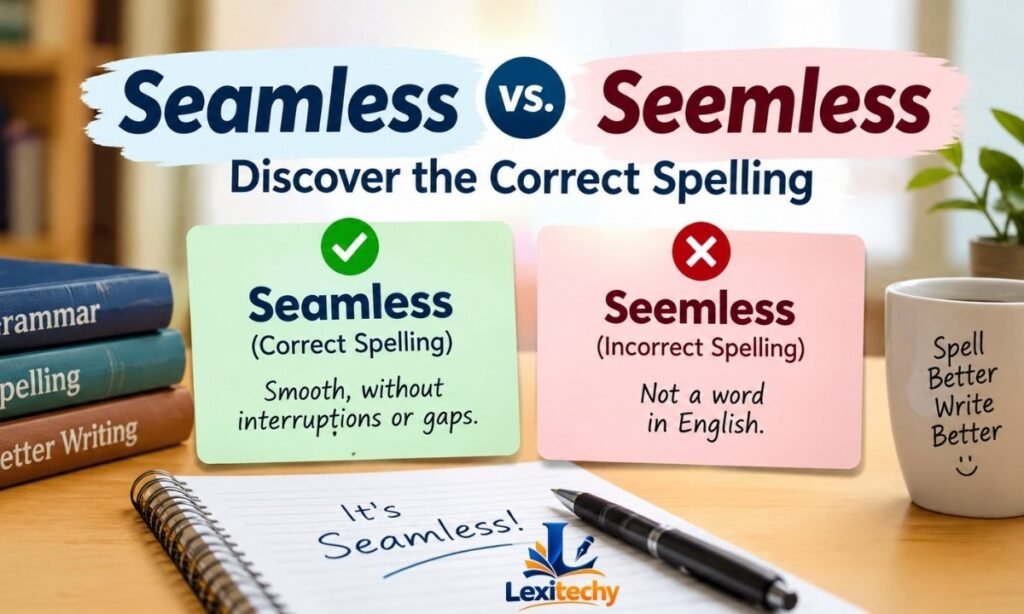
You are writing a product description, a résumé line, or a quick email, and you suddenly stop. Does that word have an “a” or a double “e”? The Seamless vs. Seemless question trips up many careful writers because both versions sound exactly the same when spoken aloud, and spell check does not always rescue you in a hurry.
Only one spelling is correct, and it is easy to remember once you see where it comes from. This article explains what the word means, how to use it in literal and figurative ways, why the mistake happens, and how to avoid it in business, technology, and everyday writing. You will also find clear examples, corrections, and simple memory tricks you can use right away.
Seamless vs. Seemless: The Quick Answer
The correct spelling is seamless. It is spelled with “ea,” just like the word “seam.” The version “seemless” is a spelling mistake and does not appear in standard American English dictionaries.
If you want a fast check, ask yourself whether the word describes something without a seam or without a visible join. If it does, the “ea” spelling is the one you need. If you are unsure, remember that “seem” is a verb about appearance, while “seam” is a noun about a joint.
What Does “Seamless” Mean?
Seamless meaning comes down to two ideas: having no seams, or flowing smoothly without gaps, breaks, or obvious transitions. It is an adjective, so it describes nouns such as a transition, a design, a process, or a garment.
The word works on two levels. One is physical and literal, and the other is figurative. Understanding both levels makes it easier to use the word correctly.
Simple Definition of Seamless
In simple terms, seamless means smooth, continuous, and free of visible breaks. Something seamless looks or feels like one connected piece, even if it was built from several parts.
Literal Meaning of Seamless
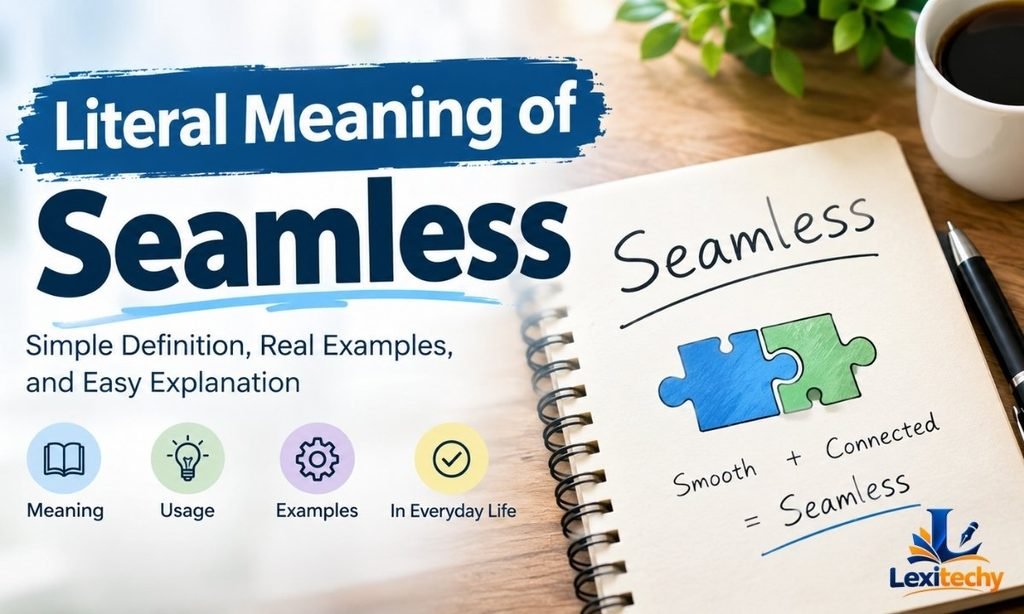
In its literal sense, seamless describes an object that has no seams. A seam is the line where two pieces of fabric, metal, or other material are joined. When a product is made as a single piece, with no stitched or welded join, it is seamless.
You will see this meaning in clothing, plumbing, and manufacturing. Seamless stockings, seamless steel pipes, and seamless gutters are common examples.
Examples
- Seamless tights that have no stitched line along the legs
- Seamless pipes made from one solid piece of metal
- Seamless flooring with no visible gaps between sections
- Seamless wallpaper patterns that repeat without a visible edge
Literal Example Sentence
“The plumber chose seamless copper pipes because they are less likely to leak at the joints.”
Figurative Meaning of Seamless
In its figurative sense, seamless describes a smooth experience with no interruptions or awkward moments. Nothing physical is being sewn or joined. The word simply paints a picture of an effortless transition from one step to the next.
This meaning is the most common one in modern writing. People use it for travel plans, software updates, teamwork, and customer service.
Figurative Example Sentence
“The new hire made a seamless transition into the team, and no one missed a beat.”
Why People Spell Seamless as Seemless
Spelling mistakes usually happen when a word sounds one way and looks another. English has many such pairs, and writers often rely on sound instead of memory. The mix-up with seemless is a good example of that habit.
Two main causes explain most of these errors.
Pronunciation Causes Confusion
“Seam” and “seem” are homophones, which means they sound identical. When you say “seamless” out loud, you hear a long “ee” sound, and your brain may link it to the more familiar spelling “ee.” Since the sound does not tell you which spelling to use, you have to rely on the meaning of the word.
The Word “Seem” Already Exists
“Seem” is a very common verb, so it feels more natural to many writers. Seeing “seem” so often makes “seem” plus “less” look reasonable. The trouble is that “seemless” would imply “not seeming,” which is not what anyone means when they use this word.
This is also why seamless vs seem less is sometimes a real source of confusion. “Seem less” is two separate words, as in “The problem seems less serious today.” That phrase has nothing to do with the adjective.
The Real Origin of the Word “Seamless”
Seamless is built from two parts: “seam” and the suffix “-less,” which means “without.” A seam is the line where two pieces are joined, so seamless literally means “without a seam.” The word’s structure shows exactly why it is spelled with “ea.”
The same suffix appears in words like “careless” and “endless.” You would never write “carless” for “careless,” so you can apply the same logic here. Build the word from its parts, and the spelling follows.
Memory Trick
Think of a tailor sewing a seam. Seams are sewn with a needle, and “seam” has an “ea.” If there is no seam, the word is seamless. Keep the “ea” and you will get it right every time.
Seamless vs. Seemless Pronunciation
Both spellings are pronounced the same way: SEEM-liss. The first syllable rhymes with “dream,” and the second syllable is a short, soft “liss.” Because the pronunciation never changes, you cannot hear the difference, which is why this error survives in emails, resumes, and social media posts.
This is a reminder that spelling and speech do not always match in English. The correct form must be learned by sight and by meaning, not by ear alone.
How Seamless Is Used in Business English
Seamless is one of the most popular words in professional writing. Companies use it to promise smooth processes that do not frustrate customers or employees. It appears in reports, pitches, job descriptions, and website copy.
Common Business Phrases
- Seamless integration
- Seamless collaboration
- Seamless onboarding
- Seamless customer service
- Seamless workflow
Example
“Our team worked together to ensure a seamless handoff between the sales and support departments.”
Seamless in Technology
Technology writers use the word constantly because good software should feel invisible. When an app works without interruptions, users describe it as seamless. The word suggests that different tools, devices, and platforms fit together without effort.
Examples in Technology
- Seamless syncing between a phone and a laptop
- Seamless software updates that run in the background
- Seamless login across multiple apps
- Seamless cloud backup
Example Sentence
“The app offers seamless syncing, so your notes appear on every device within seconds.”
Seamless in Customer Experience
Customer experience teams use the word to describe journeys with no friction. A shopper who browses, buys, and receives a package without a single problem has had a seamless experience. Companies want that outcome, so the word shows up often in service descriptions.
Areas Where Companies Use the Word
- Online checkout and payment
- Store pickup and returns
- Customer support across chat, phone, and email
- Booking and travel arrangements
Real-World Example
An airline might advertise a seamless booking process that lets travelers choose seats, add bags, and pay in a single flow. The claim only works if every step really is smooth, so the word sets an expectation that the service must meet.
Why “Seamless” Became a Popular Marketing Word
Marketers like seamless because it is short, positive, and easy to picture. It promises convenience and quality without needing a long explanation. Readers instantly understand that “seamless” means no hassle.
However, Overuse Creates Problems
When every product claims to be seamless, the word loses its force. Readers start to skim past it, and the claim can feel empty if the product does not deliver. Strong writing backs the word with specific details instead of relying on it alone.
Better Alternatives to Seamless
If you want fresh wording, several seamless synonyms can work in the right setting. Choose the one that fits your meaning most closely.

- Smooth
- Effortless
- Uninterrupted
- Continuous
- Frictionless
- Flawless
Example Comparison
- Original: “The checkout process is seamless.”
- Alternative: “The checkout takes under a minute, with no extra steps.”
The second version gives readers proof instead of a general claim.
Correct Usage Examples of Seamless
Here are clear examples of seamless in a sentence, grouped by setting. Each one uses the correct spelling.
Business Examples
- “The merger led to a seamless combination of both customer databases.”
- “She planned a seamless event from registration to closing remarks.”
Technology Examples
- “The update installed overnight with a seamless restart.”
- “The tool provides seamless access to files from any device.”
Everyday Examples
- “They made a seamless move to their new apartment in one weekend.”
- “The singer’s voice shifted from one note to the next in a seamless way.”
Incorrect Usage Examples of Seemless
Because “seemless” is not a real word, every sentence that uses it is a mistake. Seeing the errors next to the fixes makes the rule easier to remember.
Incorrect Sentences
- “The software offers a seemless login experience.”
- “We want a seemless transition for our customers.”
- “Her presentation was seemless from start to finish.”
Corrected Versions
- “The software offers a seamless login experience.”
- “We want a seamless transition for our customers.”
- “Her presentation was seamless from start to finish.”
How Spell Checkers Handle “Seemless”
Most modern writing tools flag “seemless” right away with a red underline. They suggest “seamless” as the fix, so the error is usually easy to catch when the tool is turned on. Still, a flagged word only helps if you notice it and accept the correction.
Popular Tools That Detect the Error
- Microsoft Word
- Google Docs
- Grammarly
- Built-in phone keyboards and browser spell checkers
Why Human Proofreading Still Matters
Spell checkers can be turned off, ignored, or fooled by autocorrect. They also miss mistakes in images, slides, and printed materials that were never run through a checker. A final read-through by a person catches errors that software leaves behind.
Why English Learners Struggle With Words Like Seamless
English spelling does not follow sound very closely, so learners often face words that look unrelated but sound identical. The vowel pair “ea” can be pronounced in several ways, and the long “ee” sound can be spelled “ee,” “ea,” or “ie.” That variety makes it hard to guess the correct form from the sound alone.
Learning the root word helps a great deal. When learners connect seamless to “seam,” they can build the correct spelling from meaning instead of guessing.
Similar Confusing Words
- Seam and seem
- Beat and beet
- Meat and meet
- Weak and week
- Peace and piece
The Psychology Behind Spelling Errors
Spelling mistakes are not a sign of carelessness. The brain often grabs the most familiar pattern, and “ee” is a very common spelling for the long “ee” sound. When you type quickly, your mind fills in the pattern that feels most natural.
Habit also plays a role. If you see a wrong spelling repeatedly online, it can start to look correct. This is why checking a trusted dictionary is a good habit when a word looks unfamiliar or uncertain.
Why Correct Spelling Matters in Professional Writing
Readers form opinions about writers quickly. A spelling mistake in a headline, email subject line, or product page can distract from the message and lower trust. In professional settings, small errors can raise doubts about attention to detail.
Spelling Affects First Impressions
People often judge the quality of a service by the quality of its writing. Correct spelling signals care, while a visible error can make a company seem rushed.
Example
Business A
“Experience a seamless booking process with our online scheduling tool.”
Business B
“Experience a seemless booking process with our online scheduling tool.”
Both sentences make the same promise, but the first one looks more polished. The second one asks readers to ignore a mistake before they can trust the claim.
How to Remember the Correct Spelling Forever
A few simple tricks can lock in the right spelling. Pick the one that works best for you and repeat it a few times.
Connect the Word to “Seam”
Every time you write the word, think of a seam in a piece of clothing. Seamless means “no seam,” and “seam” has an “ea.” The link is direct and easy to recall.
Visual Association Trick
Picture a smooth shirt with no stitched line down the side. The letters “ea” can remind you of “easy,” which is how a seamless process feels. This quick image can help you spell the word without stopping.
Quick Reminder Formula
Seam + less = seamless
If the word does not contain the word “seam,” it is not the right spelling.
Common Contexts Where You Should Use “Seamless”
Seamless works best when you describe something that flows without interruption or has no visible join. It fits both formal and casual writing as long as the meaning is accurate.
Appropriate Uses
- Describing smooth transitions
- Praising well-designed products or services
- Explaining manufacturing without joins
- Describing teamwork that runs without friction
Example Situations
- A manager thanks a team for a seamless product launch.
- A reviewer says a phone has seamless integration with a tablet.
- A seamstress explains that a garment is knitted in one piece with no side seams.
When You Should Avoid Using “Seamless”
Even a correctly spelled word can weaken your writing if it is overused or vague. Seamless should describe something real, not fill space.
Avoid Repetition
Using the word several times in one paragraph makes the writing sound repetitive. One well-placed use has more impact than five weak ones.
Example of Weak Writing
“Our seamless platform offers a seamless experience with seamless integration for a seamless workflow.”
Better Version
“Our platform connects with your existing tools, so your team can keep working without switching apps.”
Case Study: How One Word Changes Brand Perception
The following is an illustrative example, not a report on real companies. It shows how a single spelling choice can affect the way readers see a brand.
Landing Page A
The headline reads: “A seamless way to manage your invoices.” The page is clean, the spelling is correct, and visitors move on to read the features without hesitation.
Landing Page B
The headline reads: “A seemless way to manage your invoices.” Some visitors may notice the error right away. They might wonder whether the product itself was built with the same lack of care, even though the two pages offer identical features.
Frequrnlty Asked Questions
Is it seemless or seamless?
The correct spelling is seamless. It comes from “seam” plus “-less.” The form “seemless” is a common spelling mistake and is not accepted in standard English.
What is the meaning of seamless?
Seamless means having no seams or having a smooth flow without breaks. It can describe physical objects, processes, and experiences that feel continuous.
What is the meaning of seamless person?
“Seamless person” is not a standard phrase. People may use it informally for someone who adapts smoothly and works with others without friction.
Is it “seamless” or “seamlessly”?
“Seamless” is an adjective, as in “a seamless process.” “Seamlessly” is an adverb, as in “The tools work seamlessly together.”
Final Thoughts
The Seamless vs. Seemless debate has a clear winner. Seamless is the only correct spelling, and it comes from “seam” plus “-less,” meaning “without a seam.” The word describes both physical items with no joins and experiences that flow smoothly, and it is used widely in business, technology, and customer service.
To avoid the error, link the word to “seam” and remember that “seem” is a different word with a different meaning. Use a spell checker, but also give your writing a final read, since software can miss mistakes. When you use seamless, back it up with specific details so the word keeps its strength and your writing stays clear and professional.

Emily Carter is an English content writer and SEO specialist with 5 years of experience in creating clear, helpful, and search-friendly content. She writes about grammar, word meanings, synonyms, vocabulary, and everyday English usage. Her goal is to make confusing words and language rules simple, practical, and easy to understand.


Pingback: At Least or Atleast? Discover the Correct Spelling
Pingback: Treck or Trek? Discover the Correct Word With Easy Examples
Pingback: Gage or Gauge? Discover the Correct Spelling Fast